
1. In a car race on straight road, car $A$ takes a time $t$ less than car $B$ at the finish and passes finishing point with a speed ‘ $v$ ‘ more than that of $\operatorname{car} B$. Both the cars start from rest and travel with constant acceleration $\mathrm{a}_1$ and $a_2$ respectively. Then ‘ $v$ ‘ is equal to:KINEMATICS
(1) $\frac{a_1+a_2}{2} t$
(2) $\frac{2 a_1 a_2}{a_1+a_2} t$
(3) $\sqrt{2 a_1 a_2 t}$
(4) $\sqrt{a_1 a_2 t}$
Solution : $$ \begin{aligned} & t_A=t_B-t \\ & v_A=a_1\left(t_B-t\right)=a_2 t_B+v \\ & S=\frac{1}{2} a_1\left(t_B-t\right)^2=\frac{1}{2} a_2 t_B^2 \\ & \Rightarrow t_B\left[1-\sqrt{\frac{a_2}{a_1}}\right]=t \end{aligned} $$ Solving (i) and (ii) $v=\sqrt{a_1 a_2} t$
2. The position of a particle as a function of time $t$, is given by $x(t)=a t+b t^2-c^3$ where $\mathrm{a}, \mathrm{b}$ and $\mathrm{c}$ are constants. When the particle attains zero acceleration, then its velocity will be :
(1) $a+\frac{b^2}{4 c}$
(2) $a+\frac{b^2}{3 c}$
(3) $a+\frac{b^2}{2 c}$
(4) $a+\frac{b^2}{c}$
Solution : $$ \begin{aligned} & x=a t+b t^2-c t^3 \Rightarrow x=a+2 b t-3 c t^2 \\ & x=2 b-6 c t \end{aligned} $$ For ${ }_{\mathrm{gg}}^{\mathrm{x}}=0 \quad \mathrm{t}=+\frac{\mathrm{b}}{3 \mathrm{c}}$ $$ \begin{aligned} & \therefore \quad v=x=a+2 b\left(\frac{+b}{3 c}\right)-3 c\left(\frac{b^2}{3 c \times 3 c}\right) \\ & \Rightarrow \quad v=\frac{2 b^2}{3 c}-\frac{b^2}{3 c}+a=a+\frac{b^2}{3 c} \end{aligned} $$
3. A particle is moving with speed $v=b \sqrt{x}$ along positive $x$-axis. Calculate the speed of the particle at time $t=\tau$ (assume that the particle is at origin at $t=0$ ).
(1) $b^2 \tau$
(2) $\frac{b^2 \tau}{4}$
(3) $\frac{b^2 \tau}{2}$
(4) $\frac{b^2 \tau}{\sqrt{2}}$
Solution : \begin{aligned} & v=\frac{d x}{d t}=b \sqrt{x} \\ & \Rightarrow \quad \int_0^x \frac{d x}{\sqrt{x}}=\int_0^\tau b d t \\ & \Rightarrow \quad 2 \sqrt{x}=b \tau \\ & \Rightarrow \quad v=b \cdot \frac{b \tau}{2}=\frac{b^2 \tau}{2} \end{aligned}
4. A small ball of mass $m$ is thrown upward with velocity $u$ from the ground. The ball experiences a resistive force $\mathrm{mkv}^2$, where $\mathrm{v}$ is its speed. The maximum height attained by the ball is
(1) $\frac{1}{2 k} \tan ^{-1} \frac{k u^2}{g}$
(2) $\frac{1}{k} \ln \left(1+\frac{k u^2}{2 g}\right)$
(3) $\frac{1}{2 k} \ln \left(1+\frac{k u^2}{g}\right)$
(4) $\frac{1}{\mathrm{k}} \tan ^{-1} \frac{\mathrm{ku}^2}{2 \mathrm{~g}}$
Solution : $$ \begin{aligned} & |\mathrm{a}|=\mathrm{g}+\mathrm{kv}^2 \\ & \Rightarrow-\frac{\mathrm{vdv}}{\mathrm{dh}}=\mathrm{g}+\mathrm{kv}^2 \\ & \Rightarrow \int_u^0 \frac{\mathrm{vdv}}{\mathrm{g}+\mathrm{kv} v^2}=\int_0^{\mathrm{H}_{\max }}-\mathrm{dh} \end{aligned} $$ On solving $$ \mathrm{H}_{\max }=\frac{1}{2 \mathrm{k}} \ln \left(1+\frac{\mathrm{ku}^2}{\mathrm{~g}}\right) $$
5. A particle is projected with velocity $\mathrm{v}_0$ along $x$-axis. A damping force is acting on the particle which is proportional to the square of the distance from the origin i.e., $m a=-a x^2$.. The distance at which the particle stops:
(1) $\left(\frac{3 v_0^2}{2 \alpha}\right)^{\frac{1}{2}}$
(2) $\left(\frac{2 \mathrm{v}_0}{3 \alpha}\right)^{\frac{1}{3}}$
(3) $\left(\frac{2 v_0^2}{3 \alpha}\right)^{\frac{1}{2}}$
(4) $\left(\frac{3 v_0^2}{2 \alpha}\right)^{\frac{1}{3}}$
Solution : \begin{aligned} & F=-a x^2 \\ & m a=-a x^2 \\ & a=\frac{-\alpha x^2}{m} \\ & \frac{v d v}{d x}=\frac{\alpha}{m} x^2 \\ & \int_{v_0}^0 v d v=\int_0^x-\frac{\alpha}{m} x^2 d x \\ & \left(\frac{v^2}{2}\right)_{v_0}^0=-\frac{\alpha}{m}\left(\frac{x^3}{3}\right)_0^x \\ & \frac{-v_0^2}{2}=-\frac{\alpha}{m} \frac{x^3}{3} \\ & x=\left(\frac{3 m v_0^2}{2 \alpha}\right)^{\frac{1}{3}} \end{aligned}
6. A car accelerates from rest at a constant rate $\alpha$ for some time after which it decelerates at a constant rate $\beta$ to come to rest. If the total time elapsed is $t$ seconds, the total distance travelled is :
(1) $\frac{4 \alpha \beta}{(\alpha+\beta)} t^2$
(2) $\frac{2 \alpha \beta}{(\alpha+\beta)} t^2$
(3) $\frac{\alpha \beta}{2(\alpha+\beta)} t^2$
(4) $\frac{\alpha \beta}{4(\alpha+\beta)} t^2$
Solution :
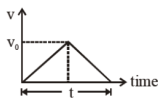
7. The instantaneous velocity of a particle moving in a straight line is given as $v=\alpha t+\beta t^2$, where $\alpha$ and $\beta$ are constants. The distance travelled by the particle between $1 \mathrm{~s}$ and $2 \mathrm{~s}$ is :
(1) $3 \alpha+7 \beta$
(2) $\frac{3}{2} \alpha+\frac{7}{3} \beta$
(3) $\frac{\alpha}{2}+\frac{\beta}{3}$
(4) $\frac{3}{2} \alpha+\frac{7}{2} \beta$
Solution : $$ \begin{aligned} & V=\alpha t+\beta t^2 \\ & \frac{d s}{d t}=\alpha t+\beta t^2 \\ & \int_{S_1}^{s_2} d s=\int_1^2\left(\alpha t+\beta t^2\right) d t \\ & S_2-S_2=\left[\frac{\alpha t^2}{2}+\frac{\beta t^3}{3}\right]_1^2 \end{aligned} $$ As particle is not changing direction so distance $=$ displacement. $$ \text { Distance }=\left[\frac{\alpha[4-1]}{2}+\frac{\beta[8-1]}{3}\right]=\frac{3 \alpha}{2}+\frac{7 \beta}{3} $$
8. A ball is thrown up with a certain velocity so that it reaches a height ‘ $h$ ‘. Find the ratio of the two different times of the ball reaching $\frac{h}{3}$ in both the directions.
(1) $\frac{\sqrt{2}-1}{\sqrt{2}+1}$
(2) $\frac{1}{3}$
(3) $\frac{\sqrt{3}-\sqrt{2}}{\sqrt{3}+\sqrt{2}}$
(4) $\frac{\sqrt{3}-1}{\sqrt{3}+1}$
Solution : $$ \mathrm{u}=\sqrt{2 \mathrm{gh}} $$ Now, $$ \begin{aligned} & S=\frac{h}{3} \quad a=-g \\ & S=u t+\frac{1}{2} a t^2 \\ & \frac{h}{3}=\sqrt{2 g h t}+\frac{1}{2}(-g) t^2 \\ & t^2\left(\frac{g}{2}\right)-\sqrt{2 g h t}+\frac{h}{3}=0 \end{aligned} $$ From quadratic equation $$ \begin{aligned} & t_1, t_2=\frac{\sqrt{2 g h} \pm \sqrt{2 g h-\frac{4 g h}{2} \frac{h}{3}}}{g} \\ & \frac{t_1}{t_2}=\frac{\sqrt{2 g h}-\sqrt{\frac{4 g h}{3}}}{\sqrt{2 g h}+\sqrt{\frac{4 g h}{3}}}=\frac{\sqrt{3}-\sqrt{2}}{\sqrt{3}+\sqrt{2}} \end{aligned} $$
9. Two buses $\mathrm{P}$ and $\mathrm{Q}$ start from a point at the same time and move in a straight line and their positions are represented by $X_P(t)=\alpha t+\beta t^2$ and $X_Q(t)=f t-t^2$. At what time, both the buses have same velocity?
(1) $\frac{\alpha-f}{1+\beta}$
(2) $\frac{\alpha+f}{2(\beta-1)}$
(3) $\frac{\alpha+f}{2(1+\beta)}$
(4) $\frac{f-\alpha}{2(1+\beta)}$
Solution: \begin{array}{ll} X_P(t)=\alpha t+\beta t^2 & X_Q=f t-t^2 \\ V_P(t)=\alpha+2 \beta t^2 & X_Q=f-2 t \\ V_P=V_Q & \\ \alpha+2 \beta t=f-2 t & \\ t=\frac{f-\alpha}{2 \beta+2} & \end{array}
10. A bullet is shot vertically downwards with an initial velocity of $100 \mathrm{~m} / \mathrm{s}$ from a certain height. Within $10 \mathrm{~s}$, the bullet reaches the ground and instantaneously comes to rest due to the perfectly inelastic collision. The velocity time curve for total time $t=20 \mathrm{~s}$ will be : $\left(\right.$ Take $\left.g=10 \mathrm{~m} / \mathrm{s}^2\right)$
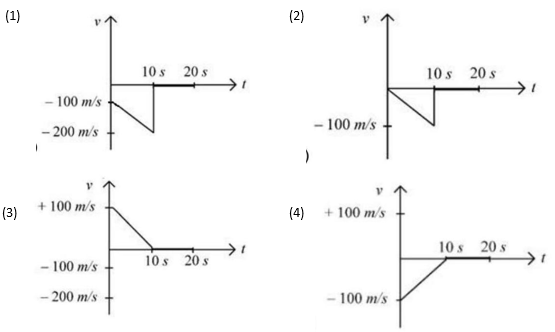
Solution: V=-100-10 t
11. Two guns $A$ and $B$ can fire bullets at speeds $1 \mathrm{~km} / \mathrm{s}$ and $2 \mathrm{~km} / \mathrm{s}$ respectively. From a point on a horizontal ground, they are fired in all possible directions. The ratio of maximum areas covered by the bullets fired by the two guns, on the ground is
(1) $1: 4$
(2) $1: 8$
(3) $1: 2$
(4) $1: 16$
Solution: \begin{equation} \frac{\mathrm{A}_1}{\mathrm{~A}_2}=\frac{\pi \mathrm{R}_{1 \max }^2}{\pi \mathrm{R}_{2 \max }^2}=\left(\frac{\mathrm{u}_1^2}{\mathrm{u}_2^2}\right)=\left(\frac{1}{4}\right)^2=\frac{1}{16} \end{equation}
12. A body is projected at $t=0$ with a velocity $10 \mathrm{~ms}^{-1}$ at an angle of $60^{\circ}$ with the horizontal. The radius of curvature of its trajectory at $t=1 \mathrm{~s}$ is $\mathrm{R}$. Neglecting air resistance and taking acceleration due to gravity $\mathrm{g}=10 \mathrm{~ms}^{-2}$, the value of $\mathrm{R}$ is
(1) $5.1 \mathrm{~m}$
(2) $2.5 \mathrm{~m}$
(3) $2.8 \mathrm{~m}$
(4) $10.3 \mathrm{~m}$
Solution: $$ \mathrm{T}=\frac{2 \mathrm{u} \sin \theta}{\mathrm{g}} $$ $$ =\frac{2 \times 10}{10} \times \frac{\sqrt{3}}{2} \quad \Rightarrow \mathrm{T}=\sqrt{3} \mathrm{~s} $$ $\mathrm{V}_{\mathrm{y}}=5 \sqrt{3}-10=-1.34 \mathrm{~ms}^{-1}$ $\mathrm{V}_{\mathrm{x}}=10 \times \frac{1}{2}=5 \mathrm{~ms}^{-1}$ $$ \left.|\tan \theta|=\left(-\frac{1.34}{5}\right) \right\rvert\, $$ $$ \theta=15^{\circ} $$ $$ R=\frac{V^2}{g \cos \theta}=\frac{26.79}{10 \times 0.97}=2.77 m ; 2.8 \mathrm{~m} $$
13. A plane is inclined at an angle $\alpha=30^{\circ}$ with respect to the horizontal. A particle is projected with a speed $u=2 \mathrm{~ms}-1$, from the base of the plane, making an angle $\theta=15^{\circ}$ with respect to the plane as shown in the figure. The distance from the base, at which the particle hits the plane is close to: (Take $\mathrm{g}=10 \mathrm{~ms}^{-2}$ )
(1) $18 \mathrm{~cm}$
(2) $20 \mathrm{~cm}$
(3) $14 \mathrm{~cm}$
(4) $26 \mathrm{~cm}$
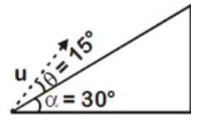
Solution: \begin{aligned} & \text { Time of flight }(T)=\frac{2 u \sin \alpha}{g \cos \beta} \\ & T=\frac{(2)(2 \sin 15)}{g \cos 30}=\frac{4 \sin 15}{10 \cos 30} \\ & \text { Range }(R)=(2 \cos 15) \mathrm{T}-\frac{1}{2} g \sin 30(\mathrm{~T})^2 \\ & = \\ & \text { (2 } \cos 15) \frac{4}{10} \frac{\sin 15}{\cos 30}-\left(\frac{1}{3} \times 10 \sin 30\right) \frac{16}{100} \frac{\sin ^2 15}{\cos ^2 30} \\ & =\frac{16 \sqrt{3}-16}{60} ; 0.1952 \mathrm{~m}=20 \mathrm{~cm} \end{aligned}
14. The trajectory of a projectile near the surface of the earth is given as $y=2 x-9 x^2$. If it were launched at an angle $\theta_0$ with speed $\mathrm{v}_0$ then $\left(\mathrm{g}=10 \mathrm{~ms}^{-2}\right)$ :
(1) $\theta_0=\sin ^{-1}\left(\frac{1}{\sqrt{5}}\right)$ and $\mathrm{v}_0=\frac{5}{3} \mathrm{~ms}^{-1}$
(2) $\theta_0=\cos ^{-1}\left(\frac{2}{\sqrt{5}}\right)$ and $\mathrm{v}_0=\frac{3}{5} \mathrm{~ms}^{-1}$
(3) $\theta_0=\cos ^{-1}\left(\frac{1}{\sqrt{5}}\right)$ and $\mathrm{v}_0=\frac{5}{3} \mathrm{~ms}^{-1}$
(4) $\theta_0=\sin ^{-1}\left(\frac{2}{\sqrt{5}}\right)$ and $\mathrm{v}_0=\frac{3}{5} \mathrm{~ms}^{-1}$
Solution: $$ y=2 x-9 x^2 $$ Comparing it with equation of trajectory
 $$
\begin{aligned}
& \mathrm{y}=\mathrm{x} \tan \theta-\frac{\mathrm{gx}^2}{\cos ^2 \theta 2 \mathrm{v}^2} \\
& \therefore \tan \theta=2
\end{aligned}
$$
And $9=\frac{10 \times 5}{2 \mathrm{v}_0^2}$
$$
\mathrm{v}_0=\frac{5}{3} \mathrm{~m} / \mathrm{s}
$$
$$
\begin{aligned}
& \mathrm{y}=\mathrm{x} \tan \theta-\frac{\mathrm{gx}^2}{\cos ^2 \theta 2 \mathrm{v}^2} \\
& \therefore \tan \theta=2
\end{aligned}
$$
And $9=\frac{10 \times 5}{2 \mathrm{v}_0^2}$
$$
\mathrm{v}_0=\frac{5}{3} \mathrm{~m} / \mathrm{s}
$$
15. Two particles are projected from the same point with the same speed $u$ such that they have the same range $\mathrm{R}$, but different maximum heights, $\mathrm{h}_1$ and $\mathrm{h}_2$. Which of the following is correct?
(1) $R^2=4 h_1 h_2$
(2) $R^2=16 h_1 h_2$
(3) $R^2=2 h_1 h_2$
(4) $R^2=h_1 h_2$
Solution: At complementary angles, ranges are equal. $$ \begin{aligned} & \therefore h_1=\frac{u^2 \sin ^2 \theta}{2 g}, h_2=\frac{u^2 \cos ^2 \theta}{2 g} \\ & \therefore h_1 \times h_2=\left(\frac{2 u^2 \sin \theta \cos \theta}{g}\right)^2 \times\left(\frac{1}{16}\right) \\ & \Rightarrow 16 h_1 h_2=R^2 \end{aligned} $$
16. The trajectory of a projectile in a vertical plane is $y=\alpha x-\beta x^2$, where $\alpha$ and $\beta$ are constants and $x \& y$ are respectively the horizontal and vertical distances of the projectile from the point of projection. The angle of projection $\theta$ and the maximum height attained $\mathrm{H}$ are respectively given by :-
(1) $\tan ^{-1} \alpha, \frac{\alpha^2}{4 \beta}$
(2) $\tan ^{-1} \beta, \frac{\alpha^2}{2 \beta}$
(3) $\tan ^{-1} \alpha, \frac{4 a^2}{\beta}$
(4) $\tan ^{-1}\left(\frac{\beta}{\alpha}\right), \frac{\alpha^2}{\beta}$
Solution: $$ y=\alpha x-\beta x^2 $$ comparing with trajectory equation $$ \begin{aligned} & y=x \tan \theta-\frac{1}{2} \frac{\mathrm{gx}^2}{\mathrm{u}^2 \cos ^2 \theta} \\ & \tan \theta=\alpha \Rightarrow \theta=\tan ^{-1} \alpha \\ & \beta=\frac{1}{2} \frac{\mathrm{g}}{\mathrm{u}^2 \cos ^2 \theta} \\ & \mathrm{u}^2=\frac{\mathrm{g}}{2 \beta \cos ^2 \theta} \end{aligned} $$ Maximum height : $\mathrm{H}$ $$ \begin{aligned} & H=\frac{u^2 \sin ^2 \theta}{2 g}=\frac{g}{2 \beta \cos ^2 \theta} u^2=\frac{\sin ^2 \theta}{2 g} \\ & H=\frac{\tan ^2 \theta}{4 \beta}=\frac{\alpha^2}{4 \beta} \end{aligned} $$
17. A player kicks a football with an initial speed of $25 \mathrm{~ms}^{-1}$ at an angle of $45^{\circ}$ from the ground. What are the maximum height and the time taken by the football to reach at the highest point during motion? (Take $\mathrm{g}=$ $10 \mathrm{~ms}^{-2}$ )
(1) $\mathrm{h}_{\max }=10 \mathrm{~m}$
(2) $\mathrm{h}_{\max }=15.625 \mathrm{~m}$
(3) $\mathrm{h}_{\max }=15.625 \mathrm{~m}$
(4) $\mathrm{h}_{\max }=3.54 \mathrm{~m}$
$\mathrm{T}=2.5 \mathrm{~s}$ $\mathrm{T}=3.54 \mathrm{~s}$ $\mathrm{T}=1.77 \mathrm{~s}$ $\mathrm{T}=0.125 \mathrm{~s}$
Solution: \begin{equation} H=\frac{U^2 \sin ^2 \theta}{2 g}=\frac{(25)^2 \cdot(\sin 45)^2}{2 \times 10}=15.625 \mathrm{~m} \end{equation} \begin{equation} \begin{aligned} & \mathrm{T}=\frac{U \sin \theta}{\mathrm{g}}=\frac{25 \times \sin 45^{\circ}}{10} \\ & =2.5 \times 0.7 \\ & =1.77 \mathrm{~s} \end{aligned} \end{equation}
18. A helicopter is flying horizontally with a speed ‘ $v$ ‘ at an altitude ‘ $h$ ‘ has to drop a food packet for a man on the ground. What is the distance of helicopter from the man when the food packet is dropped?
(1) $\sqrt{\frac{2 g h v^2+1}{h^2}}$
(2) $\sqrt{2 g h v^2+h^2}$
(3) $\sqrt{\frac{2 v^2 h}{g}+h^2}$
(4) $\sqrt{\frac{2 g h}{v^2}}+h^2$
Solution:
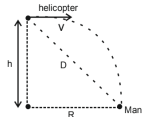
$$ \begin{aligned} & R=\sqrt{\frac{2 h}{g}} \cdot v \\ & D=\sqrt{R^2+h^2} \\ & =\sqrt{\left(\sqrt{\frac{2 h}{g}} \cdot v\right)^2+h^2} \\ & D=\sqrt{\frac{2 h v^2}{g}+h^2} \end{aligned} $$ Option (3) is correct
19. A projectile is projected with velocity of $25 \mathrm{~m} / \mathrm{s}$ at an angle $\theta$ with the horizontal. After $t$ seconds its inclination with horizontal becomes zero. If $\mathrm{R}$ represents horizontal range of the projectile, the value of $\theta$ will be: [use $\mathrm{g}=10 \mathrm{~m} / \mathrm{s}^2$ ]
(1) $\frac{1}{2} \sin ^{-1}\left(\frac{5 t^2}{4 R}\right)$
(2) $\frac{1}{2} \sin ^{-1}\left(\frac{4 R}{5 t^2}\right)$
(3) $\tan ^{-1}\left(\frac{4 t^2}{5 R}\right)$
(4) $\cot ^{-1}\left(\frac{R}{20 t^2}\right)$
Solution: \begin{aligned} & R=\frac{V^2(2 \sin \theta \cos \theta)}{g} \\ & t=\frac{V \sin \theta}{g} \Rightarrow V=\frac{g t}{\sin \theta} \\ & \Rightarrow R=\frac{g^2 t^2}{\sin ^2 \theta} \cdot \frac{2 \sin \theta \cos \theta}{g} \\ & \tan \theta=\frac{2 g t^2}{R}=\frac{20 t^2}{R} \\ & \cot \theta=\frac{R}{20 t^2} \end{aligned}
20. Given below are two statements. One is labelled as Assertion $\mathbf{A}$ and the other is labelled as Reason $\mathbf{R}$. Assertion A : Two identical balls $A$ and $B$ thrown with same velocity ‘ $u$ ‘ at two different angles with horizontal attained the same range $R$. If $A$ and $B$ reached the maximum height $h_1$ and $h_2$ respectively, then $R=4 \sqrt{h_1 h_2}$ Reason R: Product of said heights. $$ \mathrm{h}_1 \mathrm{~h}_2=\left(\frac{\mathrm{u}^2 \sin ^2 \theta}{2 \mathrm{~g}}\right) \cdot\left(\frac{\mathrm{u}^2 \cos ^2 \theta}{2 \mathrm{~g}}\right) $$ Choose the CORRECT answer:
(1) Both $A$ and $R$ are true and $R$ is the correct explanation of $A$.
(2) Both $A$ and $R$ are true but $R$ is NOT the correct explanation of $A$.
(3) $A$ is true but $R$ is false
(4) $A$ is false but $R$ is true
Solution: \begin{equation} \text { For same range } \theta_1+\theta_2=90^{\circ} \end{equation}
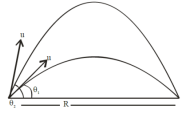
$$ \begin{aligned} & h_1=\frac{u^2 \sin ^2 \theta_1}{2 g} \quad h_2=\frac{u^2 \sin ^2 \theta_2}{2 g} \\ & h_1 h_2=\frac{u^2 \sin ^2 \theta_1}{2 g} \times \frac{u^2 \sin ^2 \theta_2}{2 g} \\ & Q_2=90-\theta_1 \\ & h_1 h_2=\frac{u^2 \sin ^2 \theta_1}{2 g} \cdot \frac{u^2 \cos ^2 \theta_1}{2 g} \\ & =\left[\frac{u^2 \sin \theta_1 \cos \theta_1}{2 g}\right]^2 \\ & =\left[\frac{u^2 \sin \theta_1 \cos \theta_1}{2 g} \times \frac{2}{2}\right]^2=\frac{R^2}{16} \\ & R=4 \sqrt{h_1 h_2} \end{aligned} $$ So $\mathrm{R}$ is correct explanation of $\mathrm{A}$
> LAWS OF MOTION
21. A mass of $10 \mathrm{~kg}$ is suspended vertically by a rope from the roof. When a horizontal force is applied on the roof at some point, the rope deviated at an angle of $45^{\circ}$ at the roof point. If the suspended mass is at equilibrium, the magnitude of the force applied is $\left(\mathrm{g}=10 \mathrm{~ms}^{-2}\right)$(1) $100 \mathrm{~N}$
(2) $200 \mathrm{~N}$
(3) $70 \mathrm{~N}$
(4) $140 \mathrm{~N}$
Solution: \begin{aligned} & \mathrm{T} \cos 45^{\circ}=\mathrm{mg} \\ & \mathrm{T} \sin 45^{\circ}=\mathrm{F} \\ & \Rightarrow \mathrm{F}=\mathrm{mg} \\ & \quad=10 \times 10=100 \mathrm{~N} \end{aligned}
22. A particle of mass $m$ is moving in a straight line with momentum $p$. Starting at time $t=0$, a force $F=k t$ acts in the same direction on the moving particle during time interval $\mathrm{T}$ so that its momentum changes from $p$ to $3 p$. Here $k$ is a constant. The value of $T$ is
(1) $\sqrt{\frac{2 k}{p}}$
(2) $2 \sqrt{\frac{p}{k}}$
(3) $\sqrt{\frac{2 p}{k}}$
(4) $2 \sqrt{\frac{k}{p}}$
Solution: \begin{aligned} & F=k t \\ & \frac{d p}{d t}=k t \quad \Rightarrow \quad \int_p^{3 p} d p=k \int_0^t t d t \\ & 2 p=\frac{k t^2}{2} \quad \Rightarrow \quad t=2 \sqrt{\frac{p}{k}} \\ & \end{aligned}
23. A block of mass $5 \mathrm{~kg}$ is (i) pushed in case (A) and (ii) pulled in case (B), by a force $F=20 \mathrm{~N}$, making an angle of $30^{\circ}$ with the horizontal, as shown in the figures. The coefficient of friction between the block and floor is $\mu=0.2$. The difference between the accelerations of the block, in case (B) and case (A) will be : ( $\mathrm{g}=10 \mathrm{~ms}^{-2}$ )
(1) $0.4 \mathrm{~ms}^{-2}$
(2) $3.2 \mathrm{~ms}^{-2}$
(3) $0 \mathrm{~ms}^{-2}$
(4) $0.8 \mathrm{~ms}^{-2}$
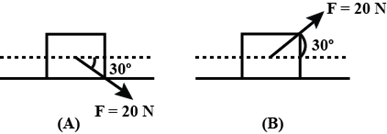
Solution: $$ \begin{aligned} & \mathrm{N}=60 \mathrm{~N} \\ & \mathrm{~F}=0.2 \times 60=12 \mathrm{~N} \\ & \mathrm{a}_{\mathrm{A}}=\frac{\left(\frac{20 \sqrt{3}}{2}-12\right)}{5}=\frac{5.3}{5}=1.06 \mathrm{~m} / \mathrm{s}^2 \end{aligned} $$
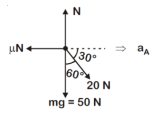
For B $$ \mathrm{N}=40 \mathrm{~N} $$ $$ \begin{aligned} & \mathrm{F}=8 \mathrm{~N} \Rightarrow \frac{20 \sqrt{3}}{2}-8=5 \mathrm{a}_{\mathrm{B}} \\ & \mathrm{a}_8=\frac{17.3-8}{5}=\frac{9.3}{5}=1.86 \mathrm{~m} / \mathrm{s}^2 \\ & \mathrm{a}_{\mathrm{B}}-\mathrm{a}_{\mathrm{A}}=0.8 \mathrm{~m} / \mathrm{s}^2 \end{aligned} $$
24. A $60 \mathrm{HP}$ electric motor lifts an elevator having a maximum total load capacity of $2000 \mathrm{~kg}$. If the frictional force on the elevator is $4000 \mathrm{~N}$, the speed of the elevator at full load is close to: $1 \mathrm{HP}=746 \mathrm{~W}, \mathrm{~g}=$ $10 \mathrm{~ms}^{-2}$ )
(1) $1.5 \mathrm{~ms}^{-1}$
(2) $1.9 \mathrm{~ms}^{-1}$
(3) $1.7 \mathrm{~ms}^{-1}$
(4) $2.0 \mathrm{~ms}^{-1}$
Solution: \begin{aligned} & F_{\text {total }}=M g+\text { friction } \\ & =2000 \times 10+4000 \\ & =20,000+4000=24000 \mathrm{~N} \\ & P=F \times v \\ & 60 \times 746=24000 \times v \\ & \Rightarrow v=1.86 \mathrm{~m} / \mathrm{s} \approx 1.9 \mathrm{~m} / \mathrm{s} \end{aligned}
25. A steel block of $10 \mathrm{~kg}$ rests on a horizontal floor as shown. When three iron cylinders are placed on it as shown, the block and cylinders go down with an acceleration $0.2 \mathrm{~m} / \mathrm{s}^2$. The normal reaction $\mathrm{R}^{\prime}$ by the floor if mass of the iron cylinders are equal and of $20 \mathrm{~kg}$ each, is $\mathrm{N}$. [Take $\mathrm{g}=10 \mathrm{~m} / \mathrm{s}^2$ and $\mu_2=0.2$ ]
(1) 716
(2) 686
(3) 714
(4) 684 $\mathrm{a}=0.2 \mathrm{~m} / \mathrm{s}^2$
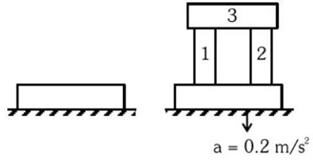
Solution: Writing force equation in vertical direction
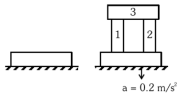 $$
\begin{aligned}
& \mathrm{Mg}-\mathrm{N}=\mathrm{Ma} \\
& \Rightarrow 70 \mathrm{~g}-\mathrm{N}=70 \times 0.2 \\
& \Rightarrow \mathrm{N}=70[\mathrm{~g}-0.2]=70 \times 9.8 \\
& \therefore \mathrm{N}=686 \text { Newton }
\end{aligned}
$$
Note : Since there is no compressive normal from the sides, hence friction will not act.
Hence option 2.
$$
\begin{aligned}
& \mathrm{Mg}-\mathrm{N}=\mathrm{Ma} \\
& \Rightarrow 70 \mathrm{~g}-\mathrm{N}=70 \times 0.2 \\
& \Rightarrow \mathrm{N}=70[\mathrm{~g}-0.2]=70 \times 9.8 \\
& \therefore \mathrm{N}=686 \text { Newton }
\end{aligned}
$$
Note : Since there is no compressive normal from the sides, hence friction will not act.
Hence option 2.
26. A force $\overrightarrow{\mathrm{F}}=(40 \hat{\mathrm{i}}+10 \hat{\mathrm{j}}) \mathrm{N}$ acts on a body of mass $5 \mathrm{~kg}$. If the body starts from rest, its position vector $\overrightarrow{\mathrm{r}}$-at time $\mathrm{t}=10 \mathrm{~s}$, will be:
(1) $(100 \hat{i}+400 \hat{j}) \mathrm{m}$
(2) $(100 \hat{i}+100 \hat{j}) \mathrm{m}$
(3) $(400 \hat{i}+100 \hat{\mathrm{j}}) \mathrm{m}$
(4) $(400 \hat{\imath}+400 \hat{j}) \mathrm{m}$
Solution: $$ \begin{aligned} & \frac{d \vec{v}}{d t}=\vec{a}=\frac{\vec{F}}{m}=(8 \hat{i}+2 \hat{j}) \mathrm{m} / \mathrm{s}^2 \\ & \frac{d \vec{r}}{d t}=\vec{v}=(8 t \hat{i}+2 t \hat{j}) \mathrm{m} / \mathrm{s} \\ & \vec{r}=(8 \hat{i}+2 \hat{j}) \frac{t^2}{2} m \end{aligned} $$ At $\mathrm{t}=10 \mathrm{sec}$ $$ \begin{aligned} & \overrightarrow{\mathrm{r}}=[(8 \hat{\mathrm{i}}+2 \hat{\mathrm{j}}) 50] \mathrm{m} \\ & \overrightarrow{\mathrm{r}}=(400 \hat{\mathrm{i}}+100 \hat{\mathrm{j}}) \mathrm{m} \end{aligned} $$
27. A particle of mass $M$ originally at rest is subjected to a force whose direction is constant but magnitude varies with time according to the relation $$ \mathrm{F}=\mathrm{F}_0\left[1-\left(\frac{\mathrm{t}-\mathrm{T}}{\mathrm{T}}\right)^2\right] $$ Where $F_0$ and $T$ are constant. The force acts only for the time interval $2 T$. The velocity $v$ of the particle after time $2 T$ is :
(1) $2 \mathrm{~F}_0 \mathrm{~T} / \mathrm{M}$
(2) $\mathrm{F}_0 \mathrm{~T} / 2 \mathrm{M}$
(3) $4 \mathrm{~F}_0 \mathrm{~T} / 3 \mathrm{M}$
(4) $F_0 T / 3 M$
Solution: $$ \begin{aligned} & t=0, u=0 \\ & a=\frac{F_0}{M}-\frac{F_0}{M T^2}(t-T)^2=\frac{d v}{d t} \\ & \int_0^v d v=\int_{t=0}^{2 T}\left(\frac{F_0}{M}-\frac{F_0}{M T^2}(t-T)^2\right) d t \\ & V=\left[\frac{F_0}{M} t\right]_0^{2 T}-\frac{F_0}{M T^2}\left[\frac{t^3}{3}-t^2 T+T^2 t\right]_0^{2 T} \\ & V=\frac{4 F_0 T}{3 M} \end{aligned} $$
28. The boxes of masses $2 \mathrm{~kg}$ and $8 \mathrm{~kg}$ are connected by a massless string passing over smooth pulleys. Calculate the time taken by box of mass $8 \mathrm{~kg}$ to strike the ground starting from rest. $$ \text { (use } \mathrm{g}=10 \mathrm{~m} / \mathrm{s}^2 \text { ) } $$
(1) $0.34 \mathrm{~s}$
(2) $0.2 \mathrm{~s}$
(3) $0.25 \mathrm{~s}$
(4) $0.4 \mathrm{~s}$
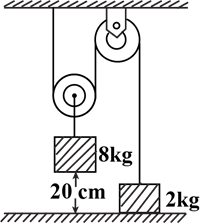
Solution: \begin{aligned} & \left(m_1 g-2 T\right)=m_1 a-(1) \\ & T-m_2 g=m_2(2 a) \end{aligned} \begin{aligned} & 2 \mathrm{~T}-2 \mathrm{~m}_2 \mathrm{~g}=4 \mathrm{~m}_2 \mathrm{a}-(2) \\ & \mathrm{m}_1 \mathrm{~g}-2 \mathrm{~m}_2 \mathrm{~g}=\left(\mathrm{m}_1+4 \mathrm{~m}_2\right) \mathrm{a} \\ & \mathrm{a}=\frac{(8-4) \mathrm{g}}{(8+8)}=\frac{4}{16} \mathrm{~g}=\frac{\mathrm{g}}{4} \\ & \mathrm{a}=\frac{10}{4} \mathrm{~m} / \mathrm{s}^2 \\ & \mathrm{~S}=\frac{1}{2} a \mathrm{t}^2 \\ & \frac{0.2 \times 2 \times 4}{10}=\mathrm{t}^2 \\ & \mathrm{t}=0.4 \mathrm{sec} \end{aligned}
29. A block of mass $m$ slides on the wooden wedge, which in turn slides backward on the horizontal surface. The acceleration of the block with respect to the wedge is: Given $m=8 \mathrm{~kg}, M=16 \mathrm{~kg}$ Assume all the surfaces shown in the figure to be frictionless.
(1) $\frac{4}{3} g$
(2) $\frac{6}{5} g$
(3) $\frac{3}{5} g$
(4) $\frac{2}{3} g$
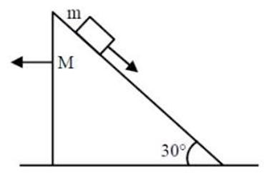
Solution:
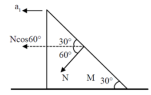
Let acceleration of wedge is $a_1$ and acceleration of block w.r.t. wedge is $a_2$ $$\mathrm{N} \cos 60=\mathrm{Ma}_1=16 \mathrm{a}_1$$ $$ \Rightarrow \mathrm{N}=32 \mathrm{a}_1 $$ F.B.D. of block w.r.t wedge
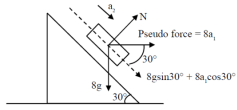
$\perp$ to incline $$ \begin{aligned} & \mathrm{N}=8 \mathrm{~g} \cos 30^{\circ}-8 \mathrm{a}_1 \sin 30^{\circ} \Rightarrow 32 \mathrm{a}_1= \\ & 4 \sqrt{3} \mathrm{~g}-4 \mathrm{a}_1 \\ & \Rightarrow \mathrm{a}_1=\frac{\sqrt{3}}{9} \mathrm{~g} \end{aligned} $$ Along incline $$ \begin{aligned} & 8 \mathrm{~g} \sin 30^{\circ}+8 \mathrm{a}_1 \cos 30^{\circ}=\mathrm{ma}_2=8 \mathrm{a}_2 \\ & \mathrm{a}_2=\mathrm{g} \times \frac{1}{2}+\frac{\sqrt{3}}{9} \mathrm{~g} \cdot \frac{\sqrt{3}}{2}=\frac{2 \mathrm{~g}}{3} \end{aligned} $$ Option (4)
30. An object of mass ‘ $m$ ‘ is being moved with a constant velocity under the action of an applied force of $2 \mathrm{~N}$ along a frictionless surface with following surface profile.
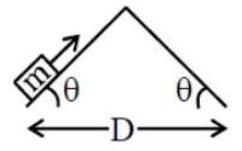
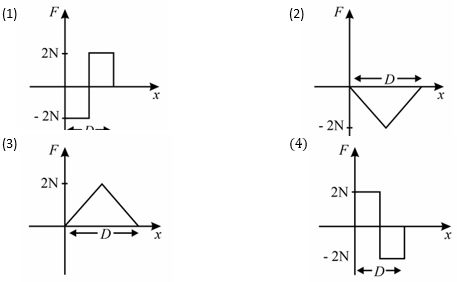
The correct applied force vs distance graph will be:
Solution:
During upward motion
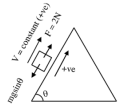
$$\mathrm{F}=2 \mathrm{~N}=(+\mathrm{ve}) constant$$ During downward motion
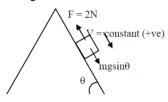
$\Rightarrow \mathrm{F}=2 \mathrm{~N}=(-\mathrm{ve})$ constant $\Rightarrow$ Best possible answer is option (2)
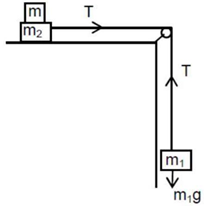
31. Two masses $m_1=5 \mathrm{~kg}$ and $m_2=10 \mathrm{~kg}$ connected by an inextensible string over a frictionless pulley are moving as shown in the figure. The coefficient of friction of horizontal surface is 0.15 . The minimum weight $m$ that should be put on top of $m_2$ to stop the motion is :
(1) $43.3 \mathrm{~kg}$
(2) $10.3 \mathrm{~kg}$
(3) $18.3 \mathrm{~kg}$
(4) $23.33 \mathrm{~kg}$
Solution:
$\begin{aligned} & \mu\left(m+m_2\right)=m_1 \\ & m+m_2=\frac{m_1}{\mu} \\ \Rightarrow m=\frac{m_1}{\mu}-m_2 \\ & m=\frac{5}{0.15}-10 \\ =23.33 \mathrm{~kg}\end{aligned}$
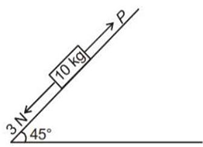
32. A block of mass $10 \mathrm{~kg}$ is kept on a rough inclined plane as shown in the figure. A force of $3 \mathrm{~N}$ is applied on the block. The coefficient of static friction between the plane and the block is 0.6 . What should be the minimum value of force $P$, such that the block doesnot move downward? (take $\mathrm{g}=10 \mathrm{~ms}^{-2}$ )
(1) $25 \mathrm{~N}$
(2) $32 \mathrm{~N}$
(3) $18 \mathrm{~N}$
(4) $23 \mathrm{~N}$
Solution:
Friction force should be acting upward along the plane. So for state of impending motion. $$ \begin{aligned} & 3+10 \times 10 \frac{1}{\sqrt{2}} \\ =P+10 \times 10 \frac{1}{\sqrt{2}} \times \frac{6}{10} \\ & \Rightarrow 73.71-42.42=P \\ & \Rightarrow P=31.28 \approx 32 \mathrm{~N} \end{aligned} $$
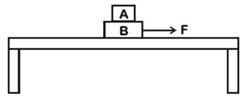
33. Two blocks $A$ and $B$ of masses $m_A=1 \mathrm{~kg}$ and $m_B=3 \mathrm{~kg}$ are kept on the table as shown in figure. The coefficient of friction between $A$ and $B$ is 0.2 and between $B$ and the surface of the table is also 0.2 . The maximum force $F$ that can be applied on $B$ horizontally, so that the block $A$ does not slide over the block $B$ is: $\left[\right.$ Take $g=10 \mathrm{~m} / \mathrm{s}^2$ ]
(1) $40 \mathrm{~N}$
(2) $12 \mathrm{~N}$
(3) $16 \mathrm{~N}$
(4) $8 \mathrm{~N}$
Solution:
$$ \begin{aligned} & a_c=\left(\frac{F-f}{M+m}\right) \\ & a=\frac{F-(0.2) 4 \times 10}{4}=\left(\frac{F-8}{4}\right) \end{aligned} $$ We have $\frac{F-8}{4} \leq(0.2) 10$ $$ \begin{array}{ll} \Rightarrow & \mathrm{F}-8 \leq 8 \\ \Rightarrow & \mathrm{F} \leq 16 \end{array} $$
$$ \begin{aligned} & a_c=\left(\frac{F-f}{M+m}\right) \\ & a=\frac{F-(0.2) 4 \times 10}{4}=\left(\frac{F-8}{4}\right) \end{aligned} $$ We have $\frac{F-8}{4} \leq(0.2) 10$ $$ \begin{array}{ll} \Rightarrow & \mathrm{F}-8 \leq 8 \\ \Rightarrow & \mathrm{F} \leq 16 \end{array} $$
34. An inclined plane making an angle of $30^{\circ}$ with the horizontal is placed in a uniform horizontal electric field $200 \frac{\mathrm{N}}{\mathrm{C}}$ as shown in the figure. A body of mass $1 \mathrm{~kg}$ and charge $5 \mathrm{mC}$ is allowed to slide down from rest at a height of $1 \mathrm{~m}$. If the coefficient of friction is 0.2 find the time taken by the body to reach the bottom. $\left[\mathrm{g}=9.8 \mathrm{~m} / \mathrm{s}^2, \sin 30^{\circ}=\frac{1}{2} ; \cos 30^{\circ}=\frac{\sqrt{3}}{2}\right]$
(1) $0.92 \mathrm{~s}$
(2) $0.46 \mathrm{~s}$
(3) $2.3 \mathrm{~s}$
(4) $1.3 \mathrm{~s}$
Solution:
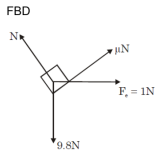
$\begin{aligned} & \text { here } N=9.8 \cos 30+1 \sin 30 \\ & \approx 9 N \\ & \text { so } a=\frac{9.8 \sin 30-1 \cos 30-\mu \mathrm{N}}{1} \\ & a=2.233 \mathrm{~m} / \mathrm{s}^2 \\ & \text { By } S=u t+\frac{1}{2} \mathrm{at}^2\end{aligned}$ $\begin{aligned} & =\frac{1}{2}(2.233) \mathrm{t}^2 \\ & \sin 30^{\circ} \\ & t \approx 1.3 \mathrm{sec} .\end{aligned}$
35. A block of mass $m$ slides along a floor while a force of magnitude $F$ is applied to it an angle $\theta$ as shown in figure. The coefficient of kinetic friction is $\mu_{\mathrm{K}}$. Then, the block’s acceleration ‘ $a$ ‘ is given by : ( $\mathrm{g}$ is acceleration due to gravity)
(1) $-\frac{F}{m} \cos \theta-\mu_k\left(g-\frac{F}{m} \sin \theta\right)$
(2) $\frac{F}{m} \cos \theta-\mu_k\left(g-\frac{F}{m} \sin \theta\right)$
(3) $\frac{F}{m} \cos \theta-\mu_k\left(g+\frac{F}{m} \sin \theta\right)$
(4) $\frac{F}{m} \cos \theta+\mu_k\left(g-\frac{F}{m} \sin \theta\right)$
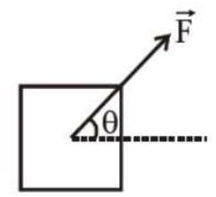
Solution:
$\begin{aligned} & N=m g-f \sin \theta \\ & F \cos \theta-\mu_k N=m a \\ & F \cos \theta-\mu_k(m g-F \sin \theta)=m a \\ & a=\frac{F}{m} \cos \theta-\mu_k\left(g-\frac{F}{m} \sin \theta\right)\end{aligned}$
36. A system of two blocks of masses $m=2 \mathrm{~kg}$ and $M=8 \mathrm{~kg}$ is placed on a smooth table as shown in figure. The coefficient of static friction between two blocks is 0.5 . The maximum horizontal force $F$ that can be applied to the block of mass $M$ so that the blocks move together will be :
(1) $9.8 \mathrm{~N}$
(2) $39.2 \mathrm{~N}$
(3) $49 \mathrm{~N}$
(4) $78.4 \mathrm{~N}$
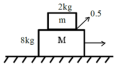
Solution:
$$ \left(\alpha_A\right)_{\max }=0.5 \mathrm{~g}=4.9 \mathrm{~m} / \mathrm{s}^2 $$ For moving together $$ \begin{aligned} & F_{\max }=m_T \alpha_A \\ & =10 \times 4.9 \\ & =49 \mathrm{~N} \end{aligned} $$
37. A body of mass $10 \mathrm{~kg}$ is moving with an initial speed of $20 \mathrm{~m} / \mathrm{s}$. The body stops after $5 \mathrm{~s}$ due to friction between body and the floor. The value of the coefficient of friction is: (Take acceleration due to gravity $\mathrm{g}=10 \mathrm{~ms}^{-2}$ )
(1) 0.2
(2) 0.3
(3) 0.5
(4) 0.4
Solution:
Net Acc. $a=\frac{20}{5} \mathrm{~m} / \mathrm{sec}^2=4 \mathrm{~m} / \mathrm{sec}^2$ Net force $F=m \times a$ Net force is provided by friction force $=\mu \times N$ $$ \begin{aligned} & \mu \times N=m \times a \\ & \mu \times m \times g=m \times a \\ & \mu=\frac{a}{g}=0.4 \end{aligned} $$
38. A uniform rod of length $I$ is being rotated in a horizontal plane with a constant angular speed about an axis passing through one of its ends. If the tension generated in the rod due to rotation is $T(x)$ at a distance $x$ from the axis, then which of the following graphs depicts it most closely?
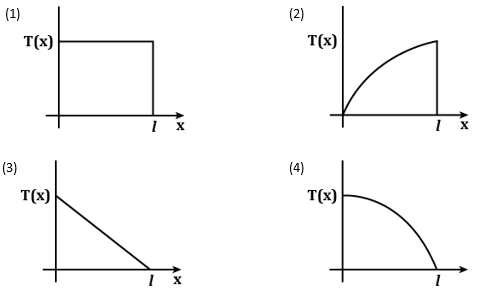
Solution:
Correct option is (4) $$ T_x=\frac{M}{L}(L-x)\left\{x+\frac{L-x}{2}\right\} \omega^2=\frac{M \omega^2}{2 L}\left(L^2-x^2\right) $$
39. A particle of mass $m$ is fixed to one end of a light spring having force constant $k$ and unstretched length $\mathrm{I}$. The other end is fixed. The system is given an angular speed $\omega$ about the fixed end of the spring such that it rotates in a circle in gravity free space. Then the stretch in the spring is
(1) $\frac{m / \omega^2}{k-\omega m}$
(2) $\frac{\mathrm{ml} \omega^2}{\mathrm{k}+\omega \mathrm{m}^2}$
(3) $\frac{m l \omega^2}{k+m \omega}$
(4) $\frac{m l \omega^2}{k-m \omega^2}$
Solution:
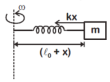
At elongated position (x), $$ \begin{aligned} & \mathrm{F}_{\text {radial }}=\mathrm{mr} \omega^2 \\ & \therefore \quad \mathrm{kx}=\mathrm{m}(\ell+\mathrm{x}) \omega^2 \\ & \therefore \quad \mathrm{x}=\frac{\mathrm{m} \ell \omega^2}{\mathrm{k}-\mathrm{m} \omega^2} \end{aligned} $$
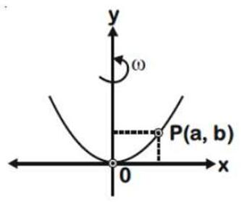
40. A bead of mass $m$ stays at point $P(a, b)$ on a wire bent in the shape of a parabola $y=4 C x^2$ and rotating with angular speed $\omega$ (see figure). The value of $\omega$ is (neglect friction)
(1) $2 \sqrt{2 g C}$
(2) $2 \sqrt{g C}$
(3) $\sqrt{\frac{2 g}{c}}$
(4) $\sqrt{\frac{2 g c}{a b}}$
Solution:
$$ \begin{aligned} & y=4 C x^2 \\ & \Rightarrow \quad \frac{d y}{d x}=\tan \theta=8 C x \end{aligned} $$ At $P, \tan \theta=8 \mathrm{Ca}$ For steady circular motion $$ \begin{aligned} & \mathrm{mg} \sin \theta=m \omega^2 \mathrm{a} \cos \theta \\ \Rightarrow \quad & \tan \theta=\frac{\omega^2 \mathrm{a}}{\mathrm{g}} \Rightarrow 8 \mathrm{Ca} \times \mathrm{g}=\omega^2 \times \mathrm{a} \\ \Rightarrow \quad & \omega=\sqrt{8 \mathrm{gC}} \Rightarrow \omega=2 \sqrt{2 \mathrm{gC}} \end{aligned} $$
> WORK, ENERGY, AND POWER
41. A particle is moving in a circular path of radius a under the action of an attractive potential $U=-\frac{k}{2 r^2}$. Its total energy is :(1) zero
(2) $-\frac{3}{2} \frac{k}{a^2}$
(3) $-\frac{k}{4 a^2}$
(4) $\frac{k}{2 a^2}$
Solution:
$\begin{aligned} & U=-\frac{k}{2 r^2} \\ & F=-\frac{d u}{d r}=-\left(-\frac{K}{2}\left(-\frac{2}{r^3}\right)\right)=-\frac{K}{r^3} \\ & \frac{K}{r^3}=\frac{m v^2}{r} \Rightarrow m v^2=\frac{K}{r^2} \\ & K . E .=\frac{1}{2} m v^2=\frac{K}{2 r^2} \\ & E=P . E .+K . E .=0\end{aligned}$
42. A block of mass $m$ is kept on a platform which starts from rest with constant acceleration $\frac{g}{2}$ upward, as shown in fig. Work done by normal reaction on block in time $t$ is
(1) $\frac{3 m g^2 t^2}{8}$
(2) $\frac{\mathrm{mg}^2 \mathrm{t}^2}{8}$
(3) 0
(4) $\frac{\mathrm{mg}^2 \mathrm{t}^2}{8}$
Solution:
$\begin{aligned} & \mathrm{N}-\mathrm{mg}=\frac{\mathrm{mg}}{2} \\ & \mathrm{~N}=\frac{3 \mathrm{mg}}{2} \quad \end{aligned}$
$\begin{aligned} \Rightarrow \quad \mathrm{S}=\frac{1}{2}\left(\frac{\mathrm{g}}{2}\right) \mathrm{t}^2 \\ & \mathrm{w}=\frac{3 \mathrm{mg}}{2} \times \frac{\mathrm{g}}{4} \mathrm{t}^2 \end{aligned}$
$\begin{aligned}\Rightarrow \mathrm{w}=\frac{3 \mathrm{mg}^2}{8} \mathrm{t}^2 \end{aligned}$
43. A body of mass $1 \mathrm{~kg}$ falls freely from a height of $100 \mathrm{~m}$, on a platform of mass $3 \mathrm{~kg}$ which is mounted on a spring having spring constant $\mathrm{k}=1.25 \times \frac{10^6 \mathrm{~N}}{\mathrm{~m}}$. The body sticks to the platform and the spring’s maximum compression is found to be $x$. Given that $g=10 \mathrm{~ms}^{-2}$, the value of $x$ will be close to
(1) $80 \mathrm{~cm}$
(2) $8 \mathrm{~cm}$
(3) $2 \mathrm{~cm}$
(4) $40 \mathrm{~cm}$
Solution:
Initial compression $=\frac{3 \times 10}{k}$, since spring constant is high. So initial compression is low. Let $v_1$ be velocity after collision. $$ \begin{aligned} & 4 \mathrm{v}_1=\mathrm{v}_0 \\ & \mathrm{v}_0=\sqrt{2 \mathrm{~g} \times 100} \\ & \frac{1}{2} \times 4 \times \mathrm{v}_1^2=\frac{1}{2} \mathrm{kx}^2 \\ & \mathrm{x}=2 \mathrm{~cm} \end{aligned} $$
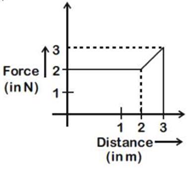
44. A particle moves in one dimension from rest under the influence of a force that varies with the distance travelled by the particle as shown in the figure. The kinetic energy of the particle after it has travelled $3 \mathrm{~m}$ is
(1) $4 \mathrm{~J}$
(2) $2.5 \mathrm{~J}$
(3) $5 \mathrm{~J}$
(4) $6.5 \mathrm{~J}$
Solution:
Area under $\mathrm{F}-\mathrm{x}$ graph Area under $\mathrm{F}-\mathrm{x}$ graph $$ \begin{aligned} & \Delta K . E= W \\ & =\frac{1}{2} \times(3+2) \times(3-2)+2 \times 2 \\ & =2.5+4 \\ & =6.5 \mathrm{~J} \end{aligned} $$
45. A uniform cable of mass ‘ $M$ ‘ and length ‘ $L$ ‘ is placed on a horizontal surface such that its $\left(\frac{1}{n}\right)^{\text {th }}$ part is hanging below the edge of the surface. To lift the hanging part of the cable upto the surface, the work done should be:
(1) $\frac{M g L}{n^2}$
(2) $\mathrm{nMgL}$
(3) $\frac{M g L}{2 n^2}$
(4) $\frac{2 M g L}{n^2}$
Solution:
$\begin{aligned} & m_1=\frac{M}{n} \\ & U_i=\frac{-M}{n} \times g \frac{L}{2 n} \quad \Rightarrow \\ & W=\frac{M g L}{2 n^2} \end{aligned}$
46. A spring whose unstretched length is I has a force constant $k$. The spring is cut into two pieces of unstretched lengths $l_1$ and $l_2$ where, $l_1=n l_2$ and $n$ is an integer. The ratio $k_1 / k_2$ of the corresponding force constants, $\mathrm{k}_1$ and $\mathrm{k}_2$ will be
(1) $n^2$
(2) $\frac{1}{n^2}$
(3) $n$
(4) $\frac{1}{n}$
Solution:
$\begin{aligned} & \mathrm{l}_1=\mathrm{nl}_2 \\ & \because \mathrm{k} \propto \frac{1}{\mathrm{I}}\end{aligned}$
$\therefore \frac{k_1}{k_2}=\frac{l_2}{l_1}=\frac{1}{n}$
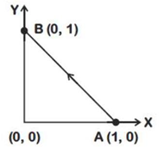
47. Consider a force $\vec{F}=-x \hat{\imath}+y \hat{\jmath}$. The work done by this force in moving a particle from point $A(1,0)$ to $B(0,1)$ along the line segment is : (all quantities are in SI units)
(1) 2
(2) 1
(3) $\frac{1}{2}$
(4) $\frac{3}{2}$
Solution:
$\begin{aligned} & W=\int d W \\ & =\int(-x \hat{i}+y \hat{j}) \cdot(d x \hat{i}+d y \hat{j}) \\ & W=\int_1^0 x d x+\int_0^1 y d y \\ & =\frac{1}{2}+\frac{1}{2}=1 J\end{aligned}$
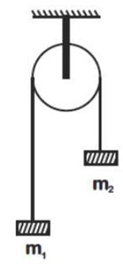
48. A uniformly thick wheel with moment of inertia $I$ and radius $R$ is free to rotate about its centre of mass (see fig.), A massless string is warapped over its rim and two blocks of masses $m_1$ and $m_2\left(m_1>m_2\right)$ are attached to the ends of the string. The system is released from rest. The angular speed of the wheel when $m_1$ descents by a distance $h$ is
(1) $\left[\frac{\left(m_1-m_2\right)}{\left(m_1+m_2\right) R^2+l}\right]^{\frac{1}{2}} g h$
(2) $\left[\frac{2\left(m_1-m_2\right) g h}{\left(m_1+m_2\right) R^2+1}\right]^{\frac{1}{2}}$
(3) $\left[\frac{m_1-m_2}{\left(m_1+m_2\right) R^2+l}\right]^{\frac{1}{2}} g h$
(4) $\left[\frac{2\left(m_1-m_2\right) g h}{\left(m_1+m_2\right) R^2+1}\right]^{\frac{1}{2}}$
Solution:
$\begin{aligned} & \Delta K+\Delta U=0 \\ & \frac{1}{2} m_1 v^2+\frac{1}{2} m_2 v^2+\frac{1}{2} l \frac{v^2}{r^2} \\ & =\left(m_1-m_2\right) g h \\ & v=\sqrt{\frac{2\left(m_1-m_2\right) g h}{m_1+m_2+\frac{1}{r^2}}} \\ & w=\frac{V}{r}\end{aligned}$
49. If the potential energy between two molecules is given by $U=\frac{A}{r^6}+\frac{B}{r^{12}}$, then at equilibrium, separation between molecules, and the potential energy are
(1) $\left(\frac{2 B}{A}\right)^{\frac{1}{6}},-\frac{A^2}{2 B}$
(2) $\left(\frac{B}{2 A}\right)^{\frac{1}{6}},-\frac{A^2}{2 B}$
(3) $\left(\frac{2 B}{A}\right)^{\frac{1}{6}},-\frac{A^2}{4 B}$
(4) $\left(\frac{B}{A}\right)^{\frac{1}{6}}, 0$
Solution:
$\begin{aligned} & F=\frac{d u}{d r} \\ & =-\left[\frac{6 A}{r^7}-\frac{12 B}{r^{13}}\right] \\ & F=0 \\ & \Rightarrow \quad r=\left(\frac{2 B}{A}\right)^{1 / 6} \\ & U\left(\text { at } r=\left(\frac{2 B}{A}\right)^{1 / 6}\right)=-\frac{A^2}{4 B}\end{aligned}$
50. Two identical blocks $A$ and $B$ each of mass $m$ resting on the smooth horizontal floor are connected by a light spring of natural length $L$ and spring constant $K$. A third block $C$ of mass $m$ moving with a speed $v$ along the line joining $A$ and $B$ collides with $A$. The maximum compression in the spring is
(1) $v \sqrt{\frac{M}{2 K}}$
(2) $\sqrt{\frac{m v}{2 K}}$
(3) $\sqrt{\frac{m v}{K}}$
(4) $\sqrt{\frac{m}{2 K}}$
Solution:
C comes to rest $$ \begin{aligned} & V_{c m} \text { of } A \& B=\frac{v}{2} \\ & \Rightarrow \frac{1}{2} \text { is } v_{\text {ret }}^2=\frac{1}{2} k x^2 \\ & x=\sqrt{\frac{\mu \times v^2}{k}}=\sqrt{\frac{m}{2 k} v} \end{aligned} $$
> ROTATIONAL MOTION
51. It is found that if a neutron suffers an elastic collinear collision with deuterium at rest, fractional loss of its energy is $p_d$, while for its similar collision with carbon nucleus at rest, fractional loss of energy is $p_c$. The values of $p_d$ and $p_c$ are respectively:(1) $(0,0)$
(2) $(0,1)$
(3) $(.89, .28)$
(4) $(.28, .89)$
Solutioh:
Case-I $$ \begin{aligned} & 2 V_2-V_1=V \\ & V_2+V_1=V \\ & 3 V_2=2 V \end{aligned} $$ $$ V_2=\frac{2 V}{3} $$ $$ v_1=\frac{V}{3} $$ $$ \mathrm{p}_{\mathrm{d}}=\frac{\frac{1}{2} m V^2-\frac{1}{2} m V_1^2}{\frac{1}{2} m V^2} $$ $$ =\frac{1-\frac{1}{9}}{1}=\frac{8}{9}=0.89 $$
Case-II $$ \begin{aligned} & 12 \mathrm{~V}_2-\mathrm{V}_1=\mathrm{V} \\ & \mathrm{V}_2+\mathrm{V}_1=\mathrm{V} \\ & 13 \mathrm{~V}_2=2 \mathrm{~V} \\ & \mathrm{~V}_2=\frac{2 \mathrm{~V}}{13} \\ & \mathrm{~V}_1=\mathrm{V}-\frac{2 \mathrm{~V}}{13}=\frac{11 \mathrm{~V}}{13} \end{aligned} $$ $$ P_c=\frac{\frac{1}{2} m v^2-\frac{1}{2} m v_1^2}{\frac{1}{2} m v^2} $$ $$ =\frac{1-\frac{121}{169}}{1} $$ $$ =\frac{48}{169}=0.28 $$
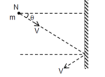
52. The mass of a hydrogen molecule is $3.32 \times 10^{-27} \mathrm{~kg}$. If $10^{23}$ hydrogen molecules strike, per second a fixed wall of area $2 \mathrm{~cm}^2$ at an angle of $45^{\circ}$ to the normal, and rebound elastically with a speed of $10^3 \mathrm{~m} / \mathrm{s}$ then the pressure on the wall is nearly :
(1) $2.35 \times 10^2 \mathrm{~N} / \mathrm{m}^2$
(2) $4.70 \times 10^2 \mathrm{~N} / \mathrm{m}^2$
(3) $2.35 \times 10^3 \mathrm{~N} / \mathrm{m}^2$
(4) $4.70 \times 10^3 \mathrm{~N} / \mathrm{m}^2$
Solution:
$\begin{aligned} & \mathrm{F}_{\text {ovg }}=2 \mathrm{NmV} \cos \theta \\ & \text { Pressure }=\frac{2 \mathrm{NmV} \cos \theta}{\mathrm{A}}\end{aligned}$
$\begin{aligned} & =\frac{2\left(10^{23}\right)\left(3.32 \times 10^{-27}\right) \frac{1}{\sqrt{2}} \times 10^3}{2 \times 10^{-4}} \\ & =2.35 \times 10^3 \mathrm{~N} / \mathrm{m}^2\end{aligned}$
53. Three blocks A, B and C are lying on a smooth horizontal surface, as shown in the figure. A and B have equal masses, $m$ while $C$ has mass $M$. Block $A$ is given an initial speed $v$ towards $B$ due to which it collides with $B$ perfectly inelastically. The combined mass collides with $C$, also perfectly inelastically $\frac{5}{6}$ th of the initial kinetic energy is lost in whole process. What is value of $\mathrm{M} / \mathrm{m}$ ?
(1) 3
(2) 4
(3) 2
(4) 5
Solution:
$$ \mathrm{K}_{\mathrm{i}}=\frac{1}{2} \mathrm{mv}_0^2 $$ Linear momentum conservation $$ \begin{aligned} & m v_0=(2 m+M) v_F \\ & v_F=\frac{m v_0}{2 m+M} \end{aligned} $$ $\Rightarrow$ According to questions $$ \begin{aligned} & K_F=\frac{K_i}{6}=\frac{K_i}{K_F}=6 \\ & \frac{\frac{1}{2} m v^2}{\frac{1}{2}(2 m+M)\left(\frac{m v}{2 m+M}\right)^2} \\ & =\frac{2 m+M}{m}=6 \\ & =\frac{M}{m}=4 \end{aligned} $$
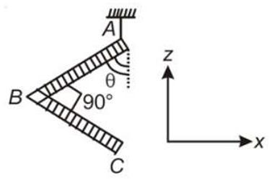
54. An L-shaped object, made of thin rods of uniform mass density, is suspended with a string as shown in figure. If $A B=B C$, and the angle made by $A B$ with downward vertical is $\theta$, then
(1) $\tan \theta=\frac{1}{2}$
(2) $\tan \theta=\frac{2}{\sqrt{3}}$
(3) $\tan \theta=\frac{1}{3}$
(4) $\tan \theta=\frac{1}{2 \sqrt{3}}$
Solution:
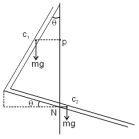
The system is in equilibrium Torque net about hinge $=0$ $$ \begin{aligned} & m g c_1 p=m g c_2 N \\ & m g \frac{L}{2} \sin \theta=m g\left(\frac{L}{2} \cos \theta-L \sin \theta\right) \\ & \tan \theta=\frac{1}{3} \end{aligned} $$
55. A piece of wood of mass $0.03 \mathrm{~kg}$ is dropped from the top of a $100 \mathrm{~m}$ height building. At the same time, a bullet of mass $0.02 \mathrm{~kg}$ is fired vertically upwards, with a velocity $100 \mathrm{~ms}^{-1}$, from the ground. The bullet gets embedded in the wood. Then the maximum height to which the combined system reaches above the top of the building before falling below is ( $\mathrm{g}=10 \mathrm{~ms}^{-2}$ )
(1) $30 \mathrm{~m}$
(2) $40 \mathrm{~m}$
(3) $20 \mathrm{~m}$
(4) $10 \mathrm{~m}$
Solution:
time taken for the particle to collide $$ \begin{aligned} & \mathrm{t}=\frac{\mathrm{d}}{\mathrm{V}_{\text {ret }}}=\frac{100}{100}=1 \mathrm{sec} \\ & \mathrm{V}_{\text {wood }}=\text { just before collision } \\ & =\mathrm{gt}=10 \mathrm{~m} / \mathrm{s} \\ & V_{\text {bullet }} \text { just before collision } \\ & =\mathrm{v}-\mathrm{gt}=100-10=90 \mathrm{~m} / \mathrm{s} \end{aligned} $$ conservation of momentum $$ \begin{aligned} & =\mathrm{m}_1 \mathrm{u}_1+\mathrm{m}_2 \mathrm{u}_2=\mathrm{m}_{\text {total }} \times \mathrm{v}_{\mathrm{c}} \\ & (0.03)(-10)+(0.02) \times 90=(0.05) \mathrm{v}_{\mathrm{c}} \\ & \mathrm{v}_{\mathrm{c}}=30 \mathrm{~m} / \mathrm{s} \\ & \mathrm{h}_{\max }=\frac{\mathrm{v}^2}{2 \mathrm{~g}}=\frac{30 \times 30}{2 \times 10}=45 \\ & \mathrm{~s}=\mathrm{ut}+\frac{1}{2} \mathrm{gt}^2 \\ & \mathrm{~s}=5 \\ & \mathrm{~h}_{\text {net }}=45-5=40 \mathrm{~m} \end{aligned} $$
56. The position vector of the centre of mass $\vec{r}_{\mathrm{cm}}$ of an asymmetric uniform bar of negligible area of crosssection as shown in figure is
(1) $\vec{r}_{c m}=\frac{5}{8} L \hat{x}+\frac{13}{8} L \hat{y}$
(2) $\vec{r}_{c m}=\frac{3}{8} L \hat{x}+\frac{11}{8} L \hat{y}$
(3) $\vec{r}_{c m}=\frac{13}{8} L \hat{x}+\frac{5}{8} L \hat{y}$
(4) $\vec{r}_{\mathrm{cm}}=\frac{11}{8} L \hat{x}+\frac{3}{8} L \hat{y}$
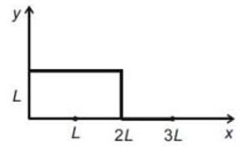
Solution:
Let assume linear mass dinsity is $\lambda$ then, $m_1=2 \mathrm{~L} \lambda$, and $\mathrm{r}_{1 \mathrm{~cm}}=(\mathrm{L}, \mathrm{L})$ $$ \begin{aligned} & \mathrm{m}_2=\mathrm{L} \lambda, \text { and } \mathrm{r}_{2 \mathrm{~cm}} \equiv\left(2 \mathrm{~L}, \frac{\mathrm{L}}{2}\right) \\ & \mathrm{m}_3=\mathrm{L} \lambda, \text { and } \mathrm{r}_{3 \mathrm{~cm}}=\left(\frac{5 \mathrm{~L}}{2}, 0\right) \\ & \therefore \quad \mathrm{X}_{\mathrm{cm}}=\frac{\mathrm{m}_1 \mathrm{x}_1+\mathrm{m}_2 \mathrm{x}_2+\mathrm{m}_3 \mathrm{x}_3}{\mathrm{~m}_1+\mathrm{m}_2+\mathrm{m}_3} \\ & \Rightarrow \quad \mathrm{X}_{\mathrm{cm}}=\frac{13}{8} \mathrm{~L} \end{aligned} $$ and, $Y_{c m}=\frac{m_1 y_1+m_2 y_2+m_3 y_3}{m_1+m_2+m_3}=\frac{5}{8} L$
57. A uniform rectangular thin sheet $A B C D$ of mass $M$ has length $a$ and breath $b$, as shown in the figure. If the shaded portion HBGO is cut-off, the coordinates of the centre of mass of the remaining portion will be:
(1) $\left(\frac{2 a}{3}, \frac{2 b}{3}\right)$
(2) $\left(\frac{5 a}{12}, \frac{5 b}{12}\right)$
(3) $\left(\frac{3 a}{4}, \frac{3 b}{4}\right)$
(4) $\left(\frac{5 a}{3}, \frac{5 b}{3}\right)$
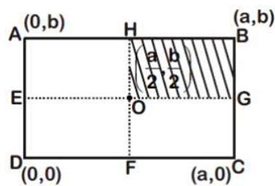
Solution:
$\mathrm{X}$ – coordinate of $\mathrm{CM}$ of remaining sheet $$ \begin{aligned} & X_{c m}=\frac{M X-m X}{M-m} \\ & =\frac{(4 m) \times\left(\frac{a}{2}\right)-m\left(\frac{3 a}{4}\right)}{4 m-m}=\frac{5 a}{12} \end{aligned} $$ Similarly $\mathrm{y}_{\mathrm{cm}}=\frac{5 \mathrm{~b}}{12}$
$\therefore \mathrm{CM}\left(\frac{5 \mathrm{a}}{12}, \frac{5 \mathrm{~b}}{12}\right)$
58. A particle of mass ‘ $m$ ‘ is moving with speed ‘ $2 v$ ‘ and collides with a mass ‘ $2 m$ ‘ moving with speed ‘ $v$ ‘ in the same direction. After collision, the first mass is stopped completely while the second one splits into two particles each of mass ‘ $m$ ‘, which move at angle $45^{\circ}$ with respect to the original direction. The speed of each of the moving particle will be
(1) $\mathrm{v} /(2 \sqrt{2})$
(2) $v / \sqrt{2}$
(3) $\sqrt{2} \mathrm{v}$
(4) $2 \sqrt{2} v$
Solution:
Initial momentum $\cdot P_i=2 m v+2 m v=4 m v$ Let $\mathrm{v}^{\prime}$ be the speed of I particle $$ \begin{array}{ll} \therefore & 2 \frac{m v^{\prime}}{\sqrt{2}}=4 m v \\ \Rightarrow & v^{\prime}=2 \sqrt{2} v \end{array} $$
59. The coordinates of centre of mass of a uniform flag shaped lamina (thin flat plate) of mass $4 \mathrm{~kg}$. (The coordinates of the same are shown in figure) are
(1) $(0.75 \mathrm{~m}, 1.75 \mathrm{~m})$
(2) $(1.25 \mathrm{~m}, 1.50 \mathrm{~m})$
(3) $(1 \mathrm{~m}, 1.75 \mathrm{~m})$
(4) $(0.75 \mathrm{~m}, 0.75 \mathrm{~m})$
Solution:
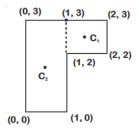
For given Lamina $$ \begin{aligned} & \mathrm{m}_1=1, \mathrm{C}_1=(1.5,2.5) \\ & \mathrm{m}_2=3, \mathrm{C}_2=(0.5,1.5) \\ & \therefore \quad \mathrm{X}_{\mathrm{cm}}=\frac{1.5+1.5}{4}=0.75 \\ & \therefore \quad \mathrm{Y}_{\mathrm{cm}}=\frac{2.5+4.5}{4}=1.75 \end{aligned} $$ $\therefore \quad$ Coordinate of centre of mass $$ (0.75,1.75) $$
60. A particle of mass $m$ is dropped from a height $h$ above the ground. At the same time another particle of the same mass is thrown vertically upwards from the ground with a speed of $\sqrt{2 g h}$. If they collide head-on completely inelastically, the time taken for the combined mass to reach the ground, in units of $\sqrt{\frac{h}{g}}$ is
(1) $\sqrt{\frac{1}{2}}$
(2) $\sqrt{\frac{3}{4}}$
(3) $\frac{1}{2}$
(4) $\sqrt{\frac{3}{2}}$
Solution:
$\begin{aligned} & \mathrm{t}_0=\frac{\mathrm{h}}{\sqrt{2 \mathrm{gh}}}=\sqrt{\frac{\mathrm{h}}{2 \mathrm{~g}}} \\ & \therefore \quad \mathrm{s}_1=\frac{1}{2} \mathrm{gt}_0^2=\frac{1}{2} \mathrm{~g} \cdot \frac{\mathrm{h}}{2 \mathrm{~g}}=\frac{\mathrm{h}}{4}\end{aligned}$
$$ \therefore \quad s_2=\frac{3 h}{4} $$ Speed of (A) just before collision $v_1 \downarrow$ $$ =\mathrm{gt}_0=\sqrt{\frac{\mathrm{gh}}{2}} $$ And speed of ( $B$ ) just before collision $v_2 \uparrow$ $$ =\sqrt{2 \mathrm{gh}}-\sqrt{\frac{\mathrm{gh}}{2}} $$ After collision velocity of centres of mass $$ V_{c m}=\frac{m\left(\sqrt{2 g h}-\sqrt{\frac{g h}{2}}\right)-m \sqrt{\frac{g h}{2}}}{2 m}=0 $$ So from there, time of fall ‘ $t$ ‘ $$ \begin{aligned} & \Rightarrow \quad \frac{3 \mathrm{~h}}{4}=\frac{1}{2} \mathrm{gt}^2 \\ & \Rightarrow \quad \mathrm{t}=\sqrt{\frac{3}{2} \frac{\mathrm{h}}{\mathrm{g}}} \\ & \end{aligned} $$
61. Shown in the figure is rigid and uniform one meter long rod $A B$ held in horizontal position by two strings tied to its ends and attached to the ceiling. The rod is of mass ‘ $m$ ‘ and has another weight of mass $2 \mathrm{~m}$ hung at a distance of $75 \mathrm{~cm}$ from $A$. The tension in the string at $A$ is
(1) $0.5 \mathrm{mg}$
(2) $2 \mathrm{mg}$
(3) $0.75 \mathrm{mg}$
(4) $1 \mathrm{mg}$
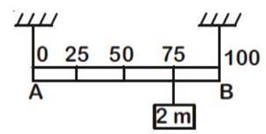
Solution:
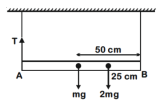
Net torque about $\mathrm{B}=0$ $$ \begin{aligned} & \Rightarrow T \times 100=m g \times 50+2 m g \times 25 \\ & \Rightarrow T=m g \end{aligned} $$
62. A block of mass $m=1 \mathrm{~kg}$ slides with velocity $v=6 \mathrm{~m} / \mathrm{s}$ on a frictionless horizontal surface and collides with a uniform vertical rod and sticks to it as shown. The rod is pivoted about 0 and swings as a result of the collision making angle $\theta$ before momentarily coming to rest. If the rod has mass $M=2 \mathrm{~kg}$ and length $\mathrm{I}=1 \mathrm{~m}$, the value of $\theta$ is approximately (take $\mathrm{g}=10 \mathrm{~m} / \mathrm{s}^2$ )
(1) $49^{\circ}$
(2) $55^{\circ}$
(3) $63^{\circ}$
(4) $69^{\circ}$
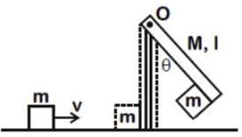
Solution:
$\begin{aligned} & \mathrm{mVI}=\left(\frac{\mathrm{M}^2}{3}+\mathrm{ml}^2\right) \omega \\ & \frac{1}{2}\left(\frac{\mathrm{Ml}^2}{3}+\mathrm{ml}^2\right) \omega^2=\left[\mathrm{Mg} \frac{1}{2}+\mathrm{mgl}\right](1-\cos \theta) \\ & \omega=\frac{18}{5} \mathrm{rad} / \mathrm{s} \\ & 1-\cos \theta=\frac{18}{5} \times \frac{3}{20} \\ & \theta=63^{\circ}\end{aligned}$
63. A uniform rod of length ‘ $l$ ‘ is pivoted at one of its ends on a vertical shaft of negligible radius. When the shaft rotates at angular speed $\omega$ the rod makes an angle $\theta$ with it (see figure). To find $\theta$ equate the rate of change of angular momentum (direction going into the paper) $\frac{\mathrm{ml}^2}{12} \omega^2 \sin \theta \cos \theta$ about the centre of mass (CM) to the torque provided by the horizontal and vertical forces $\mathrm{F}_{\mathrm{H}}$ and $\mathrm{F}_{\mathrm{V}}$ about the $\mathrm{CM}$. The value of $\theta$ is then such that
(1) $\cos \theta=\frac{g}{l \omega^2}$
(2) $\cos \theta=\frac{2 g}{31 \omega^2}$
(3) $\cos \theta=\frac{g}{2 \mid \omega^2}$
(4) $\cos \theta=\frac{3 \mathrm{~g}}{21 \omega^2}$
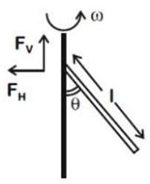
Solution:
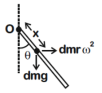
From a rotating frame rod will appear in equilibrium. Net torque about suspension point must be zero. $$ \begin{aligned} & \int_0^L\left(\frac{M}{L} d x\right)(x \sin \theta) \omega^2 x \cos \theta=M g \frac{L}{2} \sin \theta \\ & \Rightarrow \quad \cos \theta=\frac{3 g}{21 \omega^2} \end{aligned} $$
64. Four point masses, each of mass $\mathrm{m}$, are fixed at the corners of a square of side $\ell$. The square is rotating with angular frequency $\omega$, about an axis passing through one of the corners of the square and parallel to its diagonal, as shown in the figure. The angular momentum of the square about this axis is
(1) $3 \mathrm{~m} \ell^2 \omega$
(2) $4 \mathrm{~m}^2 \omega$
(3) $\mathrm{m} \ell^2 \omega$
(4) $2 \mathrm{~m} \ell^2 \omega$
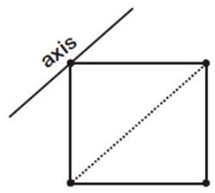
Solution:
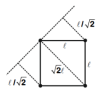
\begin{equation} \mathrm{I}=\mathrm{m}\left(\frac{\ell^2}{2}\right) \times 2+\mathrm{m} \times(\sqrt{2} \ell)^2=3 \mathrm{~m} \ell^2 \end{equation}
$\therefore \mathrm{L}=\mathrm{Iw}=3 \mathrm{~m} \ell^2 \omega$
65. The linear mass density of a thin rod $A B$ of length $L$ varies from $A$ to $B$ as $\lambda(x)=\lambda_0\left(1+\frac{x}{L}\right)$, where $x$ is the distance from $\mathrm{A}$. If $\mathrm{M}$ is the mass of the rod then its moment of inertia about an axis passing through $\mathrm{A}$ and perpendicular to the rod is
(1) $\frac{2}{5} M L^2$
(2) $\frac{5}{12} M L^2$
(3) $\frac{3}{7} \mathrm{ML}^2$
(4) $\frac{7}{18} \mathrm{ML}^2$
Solution:
$\begin{aligned} & M=\int_0^L \lambda d x=\int_0^L \lambda_0\left(1+\frac{x}{L}\right) d x \\ & =\frac{3}{2} \lambda_0 L \\ & =I=\int_0^L(\lambda d x) x^2=\frac{7}{12} \lambda_0 L^3 \\ & =I=\frac{7}{18} \mathrm{ML}^2\end{aligned}$
66. Moment of inertia (M.I.) of four bodies, having same mass and radius, are reported as i $I_1=$ M.I. of thin circular ring about its diameter. $\mathrm{I}_2=$ M.I. of circular disc about an axis perpendicular to the disc and going through the centre, $I_3=$ M.I. of solid cylinder about its axis and $\mathrm{I}_4=$ M.I. of solid sphere about its diameter. Then :
Ring $\mathrm{I}_1=\frac{\mathrm{MR}^2}{2}$ about diameter Disc
$\mathrm{I}_2=\frac{\mathrm{MR}^2}{2}$
Solid cylinder $\mathrm{I}_3=\frac{M R^2}{2}$
Solid sphere $\mathrm{I}_4=\frac{2}{5} \mathrm{MR}^2$ $I_1=I_2=I_3>I_4$
67. A sphere of radius ‘ $a$ ‘ and mass ‘ $m$ ‘ rolls along a horizontal plane with constant speed $v_0$. It encounters an inclined plane at angle $\theta$ and climbs upward. Assuming that it rolls without slipping, how far up the sphere will travel?
(1) $\frac{10 v_0^2}{7 g \sin \theta}$
(2) $\frac{v_0^2}{5 g \sin \theta}$
(3) $\frac{7}{10} \frac{\mathrm{v}^2}{\mathrm{~g}}$
(4) $\frac{v_0^2}{2 g \sin \theta}$
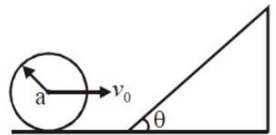
Solution:
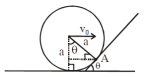
Angular momentum conservation about $$ \begin{aligned} & \mathrm{mv}_0 \mathrm{a} \cos \theta+\frac{2}{5} m a^2 \omega \\ & =\mathrm{mva}+\frac{2}{5} m a^2 \omega^1 \\ & m v_0 \times a\left[\frac{2}{5}+\cos \theta\right]=\frac{7}{5} m v a \\ & v \times \frac{5}{7}=v_0\left[\frac{2}{5}+\cos \theta\right] \\ & \frac{1}{2} m v^2+\frac{1}{2} l \omega^2=\frac{7}{10} m v^2=m g h \end{aligned} $$
68. A cord is wound round the circumference of wheel of radius $r$. The axis of the wheel is horizontal and the moment of inertia about it is $\mathrm{I}$. A weight $\mathrm{mg}$ is attached to the cord at the end. The weight falls from rest. After falling through a distance ‘ $h$ ‘, the square of angular velocity of wheel will be :-
(1) $\frac{2 m g h}{I+2 m r^2}$
(2) $\frac{2 m g h}{I+m r^2}$
(3) $2 \mathrm{gh}$
(4) $\frac{2 g h}{I+m r^2}$
Solution:
$\begin{aligned} & \mathrm{mgh}=\frac{1}{2} \mathrm{I} \omega^2+\frac{1}{2} m v^2 \\ & \mathrm{v}=\omega \mathrm{r} \\ & \left.\mathrm{mgh}=\frac{1}{2} \mathrm{I}\right)^2+\frac{1}{2} m \omega^2 \mathrm{r}^2\end{aligned}$
$\frac{2 m g h}{\left(1+m r^2\right)}=\omega^2$
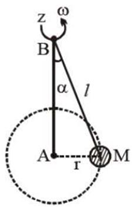
69. A mass $M$ hangs on a massless rod of length / which rotates at a constant angular frequency. The mass $M$ moves with steady speed in a circular path of constant radius. Assume that the system is in steady circular motion with constant angular velocity $\omega$. The angular momentum of $M$ about point $A$ is $L_A$ which lies in the positive $z$ direction and the angular momentum of $M$ about $B$ is $L_B$. The correct statement for this system is:
(1) $L_A$ and $L_B$ are both constant in magnitude and direction
(2) $L_B$ is constant in direction with varying magnitude
(3) $L_B$ is constant, both in magnitude and direction
(4) $L_A$ is constant, both in magnitude and direction
Solution:
We know $\vec{L}=m(\vec{r} \times \vec{v})$ Now with respect to $A$, we always get direction of $\overrightarrow{\mathrm{L}}$ along +ve $\mathrm{z}$-axis and also constant magnitude as mvr. But with respect to $B$, we get constant magnitude but continuously changing direction.
70. Consider a uniform wire of mass $M$ and length $L$. It is bent into a semicircle. Its moment of inertia about a line perpendicular to the plane of the wire passing through the centre is:
(1) $\frac{1}{4} \frac{M L^2}{\pi^2}$
(2) $\frac{2}{5} \frac{M L^2}{\pi^2}$
(3) $\frac{M L^2}{\pi^2}$
(4) $\frac{1}{2} \frac{\mathrm{ML}^2}{\pi^2}$
Solution:
$\begin{aligned} & \pi r=L \Rightarrow r=\frac{L}{\pi} \\ & I=M r^2=\frac{M L^2}{\pi^2}\end{aligned}$
> OSCILLATIONS AND WAVES
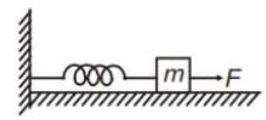
71. A block of mass $m$, lying on a smooth horizontal surface, is attached to a spring (of negligible mass) of spring constant $\mathrm{k}$. The other end of the spring is fixed, as shown in the figure. The block is initially at rest in its equilibrium position. If now the block is pulled with a constant force $F$, the maximum speed of the block is(1) $\frac{\mathrm{F}}{\pi \sqrt{\mathrm{mk}}}$
(2) $\frac{\pi \mathrm{F}}{\sqrt{\mathrm{mk}}}$
(3) $\frac{2 \mathrm{~F}}{\sqrt{\mathrm{mk}}}$
(4) $\frac{F}{\sqrt{m k}}$
Solution:
$$ \begin{array}{ll} \mathrm{T}=2 \pi \sqrt{\frac{\mathrm{m}}{\mathrm{k}}} & \\ \omega=\sqrt{\frac{\mathrm{m}}{\mathrm{k}}} \\ \mathrm{v}_{\max }=\mathrm{A} \cdot \rho & \because \mathrm{F}=\mathrm{kA}, \mathrm{A}=\frac{\mathrm{F}}{\mathrm{k}} \\ \mathrm{V}_{\max }=\frac{\mathrm{F}}{\mathrm{k}} \cdot \sqrt{\frac{\mathrm{k}}{\mathrm{m}}} \quad \Rightarrow \mathrm{V}_{\max }=\frac{\mathrm{F}}{\sqrt{\mathrm{mK}}} \end{array} $$
72. A rod of mass ‘ $M$ ‘ and length ‘ $2 L$ ‘ is suspended at its middle by a wire. It exhibits torsional oscillations; if two masses each of ‘ $m$ ‘ are attached at distance ‘ $L / 2$ ‘ from its centre on both sides, it reduces the oscillation frequency by $20 \%$. The value of ratio $\mathrm{m} / \mathrm{M}$ is close to:
(1) 0.77
(2) 0.17
(3) 0.37
(4) 0.57
Solution:
$\begin{aligned} & \mathrm{I}_1=\frac{M(2 L)^2}{12}=\frac{M L^2}{3} \\ & \mathrm{I}_2=\mathrm{I}_1+2 \frac{\mathrm{mL}^2}{4}=\frac{\mathrm{ML}^2}{3}+\frac{\mathrm{mL}^2}{2} \\ & \omega \propto \frac{1}{\sqrt{1}} \\ & \frac{\omega_1}{\omega_2}=\frac{1}{0.8}=\sqrt{\frac{\frac{M}{3}+\frac{m}{2}}{\frac{M}{3}}} \\ \quad \Rightarrow \frac{m}{M}=0.375 \\ & \end{aligned}$
73. A particle executes simple harmonic motion with an amplitude of $5 \mathrm{~cm}$. When the particle is at $4 \mathrm{~cm}$ from the mean position, the magnitude of its velocity in SI units is equal to that of its acceleration. Then, its periodic time in seconds is
(1) $\frac{4 \pi}{3}$
(2) $\frac{3}{8} \pi$
(3) $\frac{8 \pi}{3}$
(4) $\frac{7}{3} \pi$
Solution:
$\begin{aligned} & a=\omega^2 x=-\omega^2 \times 4 \\ & V=\omega \sqrt{A^2-x^2} \\ =\omega \times \sqrt{5^2-4^2} \\ & \therefore \quad \omega^2 \times 4=\omega \times 3 \\ & \Rightarrow \quad \omega=\frac{3}{4} \\ \quad \Rightarrow T=\frac{2 \pi}{3 / 4}=\frac{8 \pi}{3}\end{aligned}$
74. A particle undergoing simple harmonic motion has time dependent displacement given by $x(t)=$ $A \sin \frac{\pi t}{90}$ The ratio of kinetic to potential energy of this particle at $t=210 \mathrm{~s}$ will be
(1) 1
(2) 3
(3) 2
(4) $\frac{1}{3}$
Solution:
$\frac{K E}{P E}=\frac{\frac{1}{2} k A^2-\frac{1}{2} k A^2 \sin ^2 \frac{\pi t}{90}}{\frac{1}{2} k A^2 \sin ^2 \frac{\pi t}{90}}=\frac{1}{3}$
75. A simple pendulum of length $1 \mathrm{~m}$ is oscillating with an angular frequency $10 \mathrm{rad} / \mathrm{s}$. The support of the pendulum starts oscillating up and down with a small angular frequency of $1 \mathrm{rad} / \mathrm{s}$ and an amplitude of $10^{-2} \mathrm{~m}$. The relative change in the angular frequency of the pendulum is best given by
(1) $10^{-3} \mathrm{rad} / \mathrm{s}$
(2) $10^{-1} \mathrm{rad} / \mathrm{s}$
(3) $10^{-5} \mathrm{rad} / \mathrm{s}$
(4) $1 \mathrm{rad} / \mathrm{s}$
Solution:
$\begin{aligned} & \mathrm{T}=2 \pi \sqrt{\frac{\mathrm{I}}{\mathrm{g}_{\mathrm{ett}}}} \\ \Rightarrow \omega=\sqrt{\frac{\mathrm{g}_{\mathrm{et}}}{\mathrm{I}}} \\ & \frac{\Delta \omega}{\omega}=\frac{1}{2} \frac{\Delta \mathrm{g}_{\mathrm{etf}}}{\mathrm{g}_{\mathrm{eff}}} \\ =\frac{1}{2} \frac{\left(2 \omega^2 \mathrm{~A}\right)}{\mathrm{g}} \\ & \frac{\Delta \omega}{\omega}=10^{-3} \mathrm{rad} / \mathrm{s}\end{aligned}$
76. Two light identical springs of spring constant $k$ are attached horizontally at the two ends of a uniform horizontal $\operatorname{rod} A B$ of length $I$ and mass $m$. The rod is pivoted at its centre ‘ $O$ ‘ and can rotate freely in horizontal plane. The other ends of the two springs are fixed to rigid supports as shown in figure. The rod is gently pushed through a small angle and released. The frequency of resulting oscillation is
(1) $\frac{1}{2 \pi} \sqrt{\frac{k}{m}}$
(2) $\frac{1}{2 \pi} \sqrt{\frac{2 k}{m}}$
(3) $\frac{1}{2 \pi} \sqrt{\frac{3 k}{m}}$
(4) $\frac{1}{2 \pi} \sqrt{\frac{6 \mathrm{k}}{m}}$
Solution:
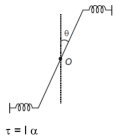
$\begin{aligned} & \frac{\mathrm{Ml}^2}{12} \alpha=2 \mathrm{k}\left(\frac{1}{2}\right)\left(\frac{1}{2}\right) \theta \\ & \frac{\mathrm{Ml}^2}{12} \alpha=\frac{-\mathrm{kl}}{2} \theta \\ & \Rightarrow \omega=\sqrt{\frac{6 \mathrm{k}}{\mathrm{m}}} \\ & \Rightarrow v=\frac{1}{2 \pi} \sqrt{\frac{6 \mathrm{~K}}{\mathrm{~m}}}\end{aligned}$
77. A simple pendulum, made of a string of length I and a bob of mass $m$, is released from a small angle $\theta_0$. It strikes a block of mass $M$, kept on a horizontal surface at its lowest point of oscillations, elastically. It bounces back and goes up to an angle $\theta_1$. Then $M$ is given by
(1) $\mathrm{m}\left(\frac{\theta_0+\theta_1}{\theta_0-\theta_1}\right)$
(2) $\frac{\mathrm{m}}{2}\left(\frac{\theta_0-\theta_1}{\theta_0-\theta_1}\right)$
(3) $\frac{m}{2}\left(\frac{\theta_0+\theta_1}{\theta_0-\theta_1}\right)$
(4) $m\left(\frac{\theta_0-\theta_1}{\theta_0+\theta_1}\right)$
Solution:
$$ \begin{aligned} &\begin{aligned} & \mathrm{u}=\omega \theta_0 \\ & \mathrm{v}=\omega \theta_1 \\ & \Rightarrow \quad \frac{\mathrm{u}}{\mathrm{v}}=\frac{\theta_0}{\theta_1} \end{aligned}\\ &\begin{aligned} & \text { Now, } v=\frac{M-m}{M+m} \times u \\ & \Rightarrow \quad \frac{M+m}{M-m}=\frac{u}{v}=\frac{\theta_0}{\theta_1} \\ & \Rightarrow \quad \frac{M}{m}=\frac{\theta_0+\theta_1}{\theta_0-\theta_1} \\ & \Rightarrow \quad M=m\left(\frac{\theta_0+\theta_1}{\theta_0-\theta_1}\right) \end{aligned} \end{aligned} $$
78. A damped harmonic oscillator has a frequency of 5 oscillations per second. The amplitude drops to half its value for every 10 oscillations. The time it will take to drop to $\frac{1}{1000}$ of the original amplitude is close to:
(1) $100 \mathrm{~s}$
(2) $10 \mathrm{~s}$
(3) $50 \mathrm{~s}$
(4) $20 \mathrm{~s}$
Solution:
Time for 10 oscillations $=\frac{10}{5}=2 \mathrm{~s}$ $$ \begin{aligned} & A=A_0 e^{-k t} \\ & \frac{1}{2}=e^{-2 k} \Rightarrow \ln 2=2 k \\ & 10^{-3}=e^{-k t} \Rightarrow 3 \ln 10=k t \\ & t=\frac{3 \ln 10}{k} \times \frac{3 \ln 10}{\ln 2} \times 2 \\ & =6 \times \frac{2.3}{0.69} \approx 20 \mathrm{~s} \end{aligned} $$
79. A simple pendulum is being used to determine the value of gravitational acceleration $g$ at a certain place. The length of the pendulum is $25.0 \mathrm{~cm}$ and a stopwatch with $1 \mathrm{~s}$ resolution measures the time taken for 40 oscillation to be $50 \mathrm{~s}$. The accuracy in $\mathrm{g}$ is
(1) $3.40 \%$
(2) $2.40 \%$
(3) $5.40 \%$
(4) $4.40 \%$
Solution:
$$ \mathrm{I}=25.0 \mathrm{~cm} $$ Time of 40 oscillation is $50 \mathrm{sec}$ $$ \begin{array}{ll} \therefore \quad \mathrm{g}=\frac{4 \pi^2 \mathrm{I}}{\mathrm{T}^2} \Rightarrow \frac{\Delta \mathrm{g}}{\mathrm{g}} \\ =\frac{\Delta \mathrm{l}}{\mathrm{l}}+\frac{2 \Delta \mathrm{T}}{\mathrm{T}} \\ \Rightarrow \quad \frac{\Delta \mathrm{g}}{\mathrm{g}}=\left(\frac{0.1}{25.0}\right)+2\left(\frac{1}{50}\right) \\ \Rightarrow \quad\left(\frac{\Delta \mathrm{g}}{\mathrm{g}} \times 100\right)=4.4 \% \end{array} $$
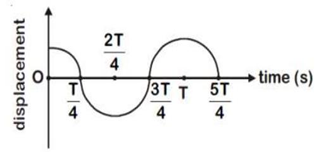
80. The displacement time graph of a particle executing S.H.M is given in figure (sketch is schematic and not to scale) Which of the following statements is/are true for this motion?
(A) The force is zero at $t=\frac{3 T}{4}$
(B) The acceleration is maximum at $\mathrm{t}=\mathrm{T}$
(C) The speed is maximum at $t=\frac{T}{4}$
(D) The P.E. is equal to K.E. of the oscillation at $t=\frac{T}{2}$
(1) (B), (C) and (D)
(2) (A) and (D)
(3) (A), (B) and (C)
(4) $(A),(B)$ and (D)
Solution:
AT $t=\frac{3 T}{4}$, particle is at mean position $\Rightarrow$ Force $=0$ At $t=T$, particle is at extreme position $\Rightarrow$ Acceleration is maximum At $t=\frac{T}{4}$, particle is at mean position $\Rightarrow$ Speed is maximum
81. The equation of a wave on a string of linear mass density $0.04 \mathrm{~kg} \mathrm{~m}^{-1}$ is given by $y=0.02(\mathrm{~m}) \sin$ $\left[2 \pi\left(\frac{t}{0.04(\mathrm{~s})}-\frac{x}{0.50(\mathrm{~m})}\right)\right]$. The tension in the string is:
(1) $4.0 \mathrm{~N}$
(2) $12.5 \mathrm{~N}$
(3) $0.5 \mathrm{~N}$
(4) $6.25 \mathrm{~N}$
Solution:
By equation $$ \begin{aligned} & f=\frac{1}{0.04} \text { and } \lambda=0.5 \\ & \Rightarrow \quad V=\frac{1}{0.04} \times 0.5=\frac{25}{2} \\ & \text { by } V=\sqrt{\frac{T}{\mu}} \\ & \Rightarrow\left(\frac{25}{2}\right)^2=\frac{T}{0.04} \\ & \Rightarrow T=\frac{625}{4} \times 0.04 \\ & T=6.25 \mathrm{~N} \end{aligned} $$
82. The transverse displacement $y(x, t)$ of a wave on a string is given by $$ y(x, t)=e^{-\left(a x^2+b t^2+2 \sqrt{a b} x t\right)} $$ This represents $\mathrm{a}$ :
(1) wave moving in $+x$-direction with speed $\sqrt{\frac{a}{b}}$
(2) wave moving in -x-direction with speed $\sqrt{\frac{b}{a}}$
(3) standing wave of frequency $\sqrt{b}$
(4) standing wave of frequency $\frac{1}{\sqrt{b}}$
Solution:
$$ y(x, t)=e^{-\left(\sqrt{a} x+\left.\sqrt{b} t\right|^2\right.} $$ It is transverse type $y(x, t)=e^{-(a x+b t)^2}$
Speed $v=\frac{\sqrt{b}}{\sqrt{a}}$ and wave is moving along $-x$ direction. $$ y(x, t)=e^{-[\sqrt{a} x+\sqrt{5 t}]^2} $$
83. A travelling wave represented by $y=A \sin ((\omega t-k x)$ is superimposed on another wave represented by $y=A \sin (\omega t+k x)$. The resultant is:
(1) A wave travelling along $+x$ direction
(2) A wave travelling along $-x$ direction
(3) A standing wave having nodes at $x=\frac{n \lambda}{2}, n=0,1,2 \ldots$.
(4) A standing wave having nodes at $x=\left(n+\frac{1}{2}\right) \frac{\lambda}{2} ; n=0,1,2 \ldots$.
Solution:
$$ Y=A \sin (\omega t-k x)+A \sin (\omega t+k x) $$ $Y=2 A \sin \omega t \operatorname{cosk} x \quad \text{standing wave} $ $$ \text{For nodes} \quad \operatorname{cosk} \mathrm{x}=0 $$ \begin{aligned} & \frac{2 \pi}{\lambda} \cdot x=(2 n+1) \frac{\pi}{2} \\ \therefore \quad & x=\frac{(2 n+1) \lambda}{4}, n=0,1,2,3, \ldots \ldots . . \end{aligned}
84. Statement – 1 : Two longitudinal waves given by equations : $y_1(x, t)=2 a \sin (\omega t-k x)$ and $y_2(x, t)=a \sin (2 \omega t-2 k x)$ will have equal intensity. Statement – 2: Intensity of waves of given frequency in same medium is proportional to square of amplitude only.
(1) Statement- 1 is true, statement- 2 is false.
(2) Statement- 1 is true, statement- 2 is true, statement- 2 is the correct explanation of statment- 1
(3) Statement- 1 is true, statement- 2 is true, statement-2 is not the correct explanation of statement-1
(4) Statement- 1 is false, statement- 2 is true.
85. A heavy ball of mass $M$ is suspended from the ceiling of a car by a light string of mass m(m < < M). When the car is at rest, the speed of transverse waves in the string is $60 \mathrm{~ms}^{-1}$. When the car has acceleration a, the wave-speed increases to $60.5 \mathrm{~ms}^{-1}$. The value of a, in terms of gravitational acceleration g, is closest to
(1) $\frac{\mathrm{g}}{30}$
(2) $\frac{g}{5}$
(3) $\frac{g}{20}$
(4) $\frac{g}{10}$
Solution:
$\begin{aligned} & v=\sqrt{\frac{T}{\mu}}=\sqrt{\frac{m g}{\mu}} \\ & v^{\prime}=\sqrt{\frac{m \sqrt{g^2+a^2}}{\mu}} \\ & \Rightarrow \frac{v^{\prime}}{v}=\sqrt{\frac{\sqrt{g^2+a^2}}{g}} \\ &\Rightarrow a=1.83 \\ & \Rightarrow a=\frac{g}{5} \\ \end{aligned}$
86. A string of length $1 \mathrm{~m}$ and mass $5 \mathrm{~g}$ is fixed at both ends. The tension in the string is $8.0 \mathrm{~N}$. The string is set into vibration using an external vibrator of frequency $100 \mathrm{~Hz}$. The separation between successive nodes on the string is close to
(1) $33.3 \mathrm{~cm}$
(2) $10.0 \mathrm{~cm}$
(3) $16.6 \mathrm{~cm}$
(4) $20.0 \mathrm{~cm}$
Solution:
$$ \begin{aligned} & v=\sqrt{\frac{T}{\mu}} \\ & =\sqrt{\frac{8 \times 1}{5 \times 10^{-3}}}=40 \mathrm{~m} / \mathrm{s} \\ & \lambda=\frac{v}{f} \\ & =\frac{40}{100}=0.4 \mathrm{~m} \end{aligned} $$ Separation between successive nodes $=\frac{\lambda}{2}$ $$ =0.2 \mathrm{~m} ; 20 \mathrm{~cm} $$
87. Equation of travelling wave on a stretched string of linear density $5 \mathrm{~g} / \mathrm{m}$ is $y=0.03 \sin (450 \mathrm{t}-9 \mathrm{x})$ where distance and time are measured in $\mathrm{SI}$ units. The tension in the string is
(1) $10 \mathrm{~N}$
(2) $7.5 \mathrm{~N}$
(3) $5 \mathrm{~N}$
(4) $12.5 \mathrm{~N}$
Solution:
$$ Y=A \sin \omega\left(t-\frac{x}{V}\right) $$ $\mathrm{V}=50 \mathrm{~m} / \mathrm{s}$ by comparison. $$ \begin{aligned} & 50=\sqrt{\frac{T}{\mu}} \\ & T=2500 \times 5 \times 10^{-3} \\ & T=12.5 \mathrm{~N} \end{aligned} $$
88. A travelling harmonic wave is represented by the equation $y(x, t)=10^{-3} \sin (50 t+2 x)$, where $x$ and $y$ are in meter and $t$ is in seconds. Which of the following is a correct statement about the wave?
(1) The wave is propagating along the negative $x$-axis with speed $25 \mathrm{~ms}^{-1}$.
(2) The wave is propagating along the positive $x$-axis with speed $100 \mathrm{~ms}^{-1}$.
(3) The wave is propagating along the negative $x$-axis with speed $100 \mathrm{~ms}^{-1}$.
(4) The wave is propagating along the positive $x$-axis with speed $25 \mathrm{~ms}^{-1}$.
Solution:
$$ \begin{aligned} & y(x, t)=10^{-3} \sin (50 t+2 x) \Rightarrow \\ & v=\frac{\omega}{k}=\frac{50}{2}=25 \mathrm{~ms}^{-1} \end{aligned} $$ And wave is travelling in -ve $x$-direction.
89. A wire of length $2 \mathrm{~L}$, is made by joining two wires $A$ and $B$ of same length but different radii $r$ and $2 r$ and made of the same material. It is vibrating at a frequency such that the joint of the two wires forms a node. If the number of antinodes in wire $A$ is $p$ and that in $B$ is $q$ then the ratio $p: q$ is
(1) $4: 9$
(2) $1: 2$
(3) $3: 5$
(4) $1: 4$
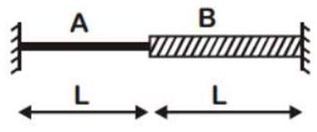
Solution:
$\begin{aligned} & \frac{V_A}{V_B}=\sqrt{\frac{\mu_B}{\mu_A}}=\frac{r_B}{r_A} 2=\frac{\lambda_A}{\lambda_B} \\ & \Rightarrow \lambda_A=2 \lambda_B \Rightarrow \frac{p}{q}=\frac{1}{2}\end{aligned}$
90. A string is clamped at both the ends and it is vibrating in its 4 th harmonic. The equation of the stationary wave is $Y=0.3 \sin (0.157 x) \cos (200 \pi t)$. The length of the string is : (All quantities are in SI units)
(1) $60 \mathrm{~m}$
(2) $20 \mathrm{~m}$
(3) $40 \mathrm{~m}$
(4) $80 \mathrm{~m}$
Solution: $$ k=0.157=\frac{3.14}{20} =\frac{\pi}{20} $$
In 4th harmonic
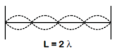
\begin{aligned}
& \therefore \mathrm{k}=\frac{2 \pi}{\lambda}=\frac{\pi}{20} \\
& \lambda=40 \mathrm{~m} \\
& \therefore \mathrm{L}=\frac{4 \lambda}{2}=80 \mathrm{~m}
\end{aligned}
91. A granite rod of $60 \mathrm{~cm}$ length is clamped at its middle point and is set into longitudinal vibrations. The density of granite is $2.7 \times 10^3 \mathrm{~kg} / \mathrm{m}^3$ and its Young’s modulus is $9.27 \times 10^{10} \mathrm{~Pa}$. What will be the fundamental frequency of the longitudinal vibrations?
(1) $10 \mathrm{kHz}$
(2) $7.5 \mathrm{kHz}$
(3) $5 \mathrm{kHz}$
(4) $2.5 \mathrm{kHz}$
Solution:
$$ \mathrm{f}_0=\frac{1}{2 \ell} \sqrt{\frac{Y}{\rho}} $$ $$ =\frac{1}{2(0.6)} \sqrt{\frac{9.27 \times 10^{10}}{2.7 \times 10^3}} $$ $$ =4.9 \times 10^3 \mathrm{~Hz} ; 5 \mathrm{kHz} $$
92. A musician using an open flute of length $50 \mathrm{~cm}$ produces second harmonic sound waves. A person runs towards the musician from another end of a hall at a speed of $10 \mathrm{~km} / \mathrm{h}$. If the wave speed is $330 \mathrm{~m} / \mathrm{s}$, the frequency heard by the running person shall be close to
(1) $500 \mathrm{~Hz}$
(2) $753 \mathrm{~Hz}$
(3) $333 \mathrm{~Hz}$
(4) $666 \mathrm{~Hz}$
Solution:
$$ \begin{aligned} & I=0.50 \\ & \lambda=\frac{1}{2} \mathrm{~m} \\ & v=330 \times 2\\ & =660 \mathrm{~Hz} \end{aligned} $$
93. A train moves towards a stationary observer with speed $34 \mathrm{~m} / \mathrm{s}$. The train sounds a whistle and its frequency registered by the observer is $\mathrm{f}_1$. If the speed of the train is reduced to $17 \mathrm{~m} / \mathrm{s}$, the frequency registered is $f_2$. If speed of sound is $340 \mathrm{~m} / \mathrm{s}$, then the ratio $\frac{f_1}{f_2}$ is
(1) $\frac{21}{20}$
(2) $\frac{20}{19}$
(3) $\frac{18}{17}$
(4) $\frac{19}{18}$
Solution:
$$ \begin{aligned} & f_1=f_0\left(\frac{340}{340-34}\right) \\ & f_2=f_0\left(\frac{340}{340-17}\right) \\ & \frac{f_1}{f_2}=\frac{340-17}{340-34} \\ & =\frac{19}{18} \end{aligned} $$
94. A closed organ pipe has a fundamental frequency of $1.5 \mathrm{kHz}$. The number of overtones that can be distinctly heard by a person with this organ pipe will be : (Assume that the highest frequency a person can hear is $20,000 \mathrm{~Hz}$ )
(1) 7
(2) 4
(3) 6
(4) 5
Solution: $$ f_0=\frac{v}{4 L} $$
Also, $f_n=(2 n+1) f_o$
So $(2 n+1)$ would take value of $$ \begin{aligned} & \frac{20000}{1500}=13.33 \\ & \Rightarrow 1,3,5,7,9,11,13 \end{aligned} $$
So overtones are $3,5,7,9,11,13$
Total 6 No. of overtones would be heard
95. A person standing on an open ground hears the sound of a jet aeroplane, coming from north at an angle $60^{\circ}$ with ground level. But he finds the aeroplane right vertically above his position. If $v$ is the speed of sound, speed of the plane is
(1) $\frac{2 v}{\sqrt{3}}$
(2) $\frac{\sqrt{3}}{2} v$
(3) $\frac{v}{2}$
(4) $v$
Solution:
$$ \begin{aligned} & A B=v_p \cdot t \\ & A C=v \cdot t \\ & \cos 60^{\circ}=\frac{A B}{A C} \\ & =\frac{v_p t}{v \cdot t} \\ & v=\frac{v_p}{2} \end{aligned} $$
96. The pressure wave, $P=0.01 \sin [1000 t-3 x] \mathrm{Nm}^{-2}$, corresponds to the sound produced by a vibrating blade on a day when atmospheric temperature is $0^{\circ} \mathrm{C}$. On some other day when temperature is $\mathrm{T}$, the speed of sound produced by the same blade and at the same frequency is found to be $336 \mathrm{~ms}^{-1}$. Approximate value of $\mathrm{T}$ is :
(1) $4^{\circ} \mathrm{C}$
(2) $12^{\circ} \mathrm{C}$
(3) $15^{\circ} \mathrm{C}$
(4) $11^{\circ} \mathrm{C}$
Solution:
$$ \begin{aligned} & V_1=\frac{1000}{3} \mathrm{~m} / \mathrm{s} \\ & V \propto \sqrt{\mathrm{T}} \\ & \frac{d V}{V}=\frac{1}{2} \frac{d T}{T} \\ & {\left[\because d v=336-\frac{1000}{3}=\frac{1008-1000}{3}=\frac{8}{3}\right]} \\ & \frac{8 \times 3}{3 \times 1000} \\ & =\frac{1}{2} \times \frac{d T}{273} \\ & d T=\frac{273 \times 2 \times 8}{1000}=4.36^{\circ} \mathrm{C} \end{aligned} $$
97. A stationary source emits sound waves of frequency $500 \mathrm{~Hz}$. Two observers moving along a line passing through the source detect sound to be of frequencies $480 \mathrm{~Hz}$ and $530 \mathrm{~Hz}$. Their respective speeds are, in $\mathrm{ms}^{-1}$, (Given speed of sound $=300 \mathrm{~m} / \mathrm{s}$ )
(1) 12,16
(2) 16,14
(3) 8,18
(4) 12,18
Solution:
Frequency of sound source $\left(f_0\right)=500 \mathrm{~Hz}$
When observer is moving away from the source
Apparent frequency $f_1=480=f_0\left(\frac{v-v_0^{\prime}}{v}\right)$
And when observer is moving towards the Source $f_2=530=f_0\left(\frac{v+v^{\prime \prime}}{v}\right)$
From equation (i) $$ \begin{aligned} & 480=500\left(\frac{300-\mathrm{v}_0^{\prime}}{300}\right) \\ & \mathrm{v}_0^{\prime}=12 \mathrm{~m} / \mathrm{s} \end{aligned} $$ From equation (ii) $$ \begin{aligned} 530 & =500\left(1+\frac{v_0{ }_0}{v}\right) \\ \therefore \quad v^{\prime \prime}{ }_0 & =18 \mathrm{~m} / \mathrm{s} \end{aligned} $$
98. A source of sound $S$ is moving with a velocity of $50 \mathrm{~m} / \mathrm{s}$ towards a stationary observer. The observer measures the frequency of the source as $1000 \mathrm{~Hz}$. What will be the apparent frequency of the source when it is moving away from the observer after crosssing him? (Take velocity of sound in air is $350 \mathrm{~m} / \mathrm{s}$ )
(1) $857 \mathrm{~Hz}$
(2) $1143 \mathrm{~Hz}$
(3) $807 \mathrm{~Hz}$
(4) $750 \mathrm{~Hz}$
Solution: $$ \begin{aligned} & \mathrm{f}_{\mathrm{app}}=\mathrm{f}_{\mathrm{act}}\left(\frac{\mathrm{V} \pm \mathrm{V}_0}{\mathrm{~V} \mp \mathrm{V}_8}\right) \\ & 1000=f_{\theta c t}\left(\frac{350-0}{350+(-50)}\right) \\ & \text { and } f^{\prime}=f_{\theta c t}\left(\frac{350}{350+50}\right) \\ & \frac{1000}{f^{\prime}}=\frac{400}{300} \\ & \Rightarrow f_{\text {at }}^{\prime}=\frac{1000 \times 300}{400} ; \\ & f_{a c t}^{\prime}=750 \mathrm{~Hz} \\ & \end{aligned} $$
99. A small speaker delivers $2 \mathrm{~W}$ of audio output. At what distance from the speaker will one detect $120 \mathrm{~dB}$ intensity sound? [Given reference intensity of sound as 10-12 W/ $/ \mathrm{m}^2$ ]
(1) $30 \mathrm{~cm}$
(2) $40 \mathrm{~cm}$
(3) $10 \mathrm{~cm}$
(4) $20 \mathrm{~cm}$
Solution: $$ \begin{aligned} & 120=10 \log _{10} \frac{1}{10^{-12}} \\ & \Rightarrow \frac{I}{10^{-12}}=10^{12} \\ & \Rightarrow I=1 \mathrm{~W} / \mathrm{m}^2 \\ & I=\frac{2}{4 \pi r^2}=1 \\ & \Rightarrow r=\sqrt{\frac{2}{4 \pi}} \\ & \mathrm{m}=0.399 \mathrm{~m} \\ & \quad=40 \mathrm{~cm} \end{aligned} $$
100. A tuning fork of frequency $480 \mathrm{~Hz}$ is used in an experiment for measuring speed of sound $(\mathrm{v})$ in air by resonance tube method. Resonance is observed to occur at two successive lengths of the air column, $\mathrm{l}_1=$ $30 \mathrm{~cm}$ and $\mathrm{I}_2=70 \mathrm{~cm}$. Then, $\mathrm{v}$ is equal to
(1) $332 \mathrm{~ms}^{-1}$
(2) $384 \mathrm{~ms}^{-1}$
(3) $379 \mathrm{~ms}^{-1}$
(4) $338 \mathrm{~ms}^{-1}$
Solution:
> PROPERTIES OF SOLID AND LIQUIDS
101. Two liquids of densities $\rho_1$ and $\rho_2\left(\rho_2=2 \rho_1\right)$ are filled up behind a square wall of side $10 \mathrm{~m}$ as shown in figure. Each liquid has a height of $5 \mathrm{~m}$. The ratio of the forces due to these liquids exerted on upper part $\mathrm{MN}$ to that at the lower part NO is (Assume that the liquids are not mixing)(1) $1 / 4$
(2) $1 / 2$
(3) $2 / 3$
(4) $1 / 3$
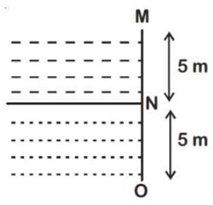
Solution:
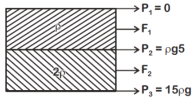 $$
\begin{aligned}
& F_1=\frac{\left(P_1+P_2\right)}{2} A \\
& F_2=\frac{\left(P_2+P_3\right)}{2} A \\
& \therefore \quad \frac{F_1}{F_2} \\
& =\frac{5 \rho g}{20 \rho g}=\frac{5}{20} \\
&=\frac{1}{4}
\end{aligned}
$$
$$
\begin{aligned}
& F_1=\frac{\left(P_1+P_2\right)}{2} A \\
& F_2=\frac{\left(P_2+P_3\right)}{2} A \\
& \therefore \quad \frac{F_1}{F_2} \\
& =\frac{5 \rho g}{20 \rho g}=\frac{5}{20} \\
&=\frac{1}{4}
\end{aligned}
$$
102. Water flows in a horizontal tube (see figure). The pressure of water changes by $700 \mathrm{Nm}^{-2}$ between $\mathrm{A}$ and $B$ where the area of cross section are $40 \mathrm{~cm}^2$ and $20 \mathrm{~cm}^2$, respectively. Find the rate of flow of water through the tube. (density of water $=1000 \mathrm{kgm}^{-3}$ )
(1) $3020 \mathrm{~cm}^3 / \mathrm{s}$
(2) $1810 \mathrm{~cm}^3 / \mathrm{s}$
(3) $2720 \mathrm{~cm}^3 / \mathrm{s}$
(4) $2420 \mathrm{~cm}^3 / \mathrm{s}$
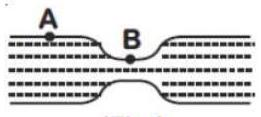
Solution: $$ \begin{aligned} & \left(P_A-P_B\right)=\frac{1}{2} \rho\left(V_B^2-V_A^2\right) \\ & \Rightarrow \quad \Delta P=\frac{1}{2} \rho\left(V_B^2-\frac{V_B^2}{4}\right) \\ & \Rightarrow \quad \Delta P=\frac{3}{8} \rho V_B^2 \\ & V_B=\sqrt{\frac{(\Delta P) 8}{3 \rho}} \\ & =\sqrt{\frac{(\Delta P) 4}{1500}} \\ & =\sqrt{\frac{700 \times 4}{1500}} \mathrm{~m} / \mathrm{s} \\ & Q=A_B V_B \\ & =(20)\left(\sqrt{\frac{28}{15}}\right) \times 100 \frac{\mathrm{cm}^3}{\mathrm{~s}} \\ & Q \approx 2720 \mathrm{~cm}^3 / \mathrm{s} \end{aligned} $$